
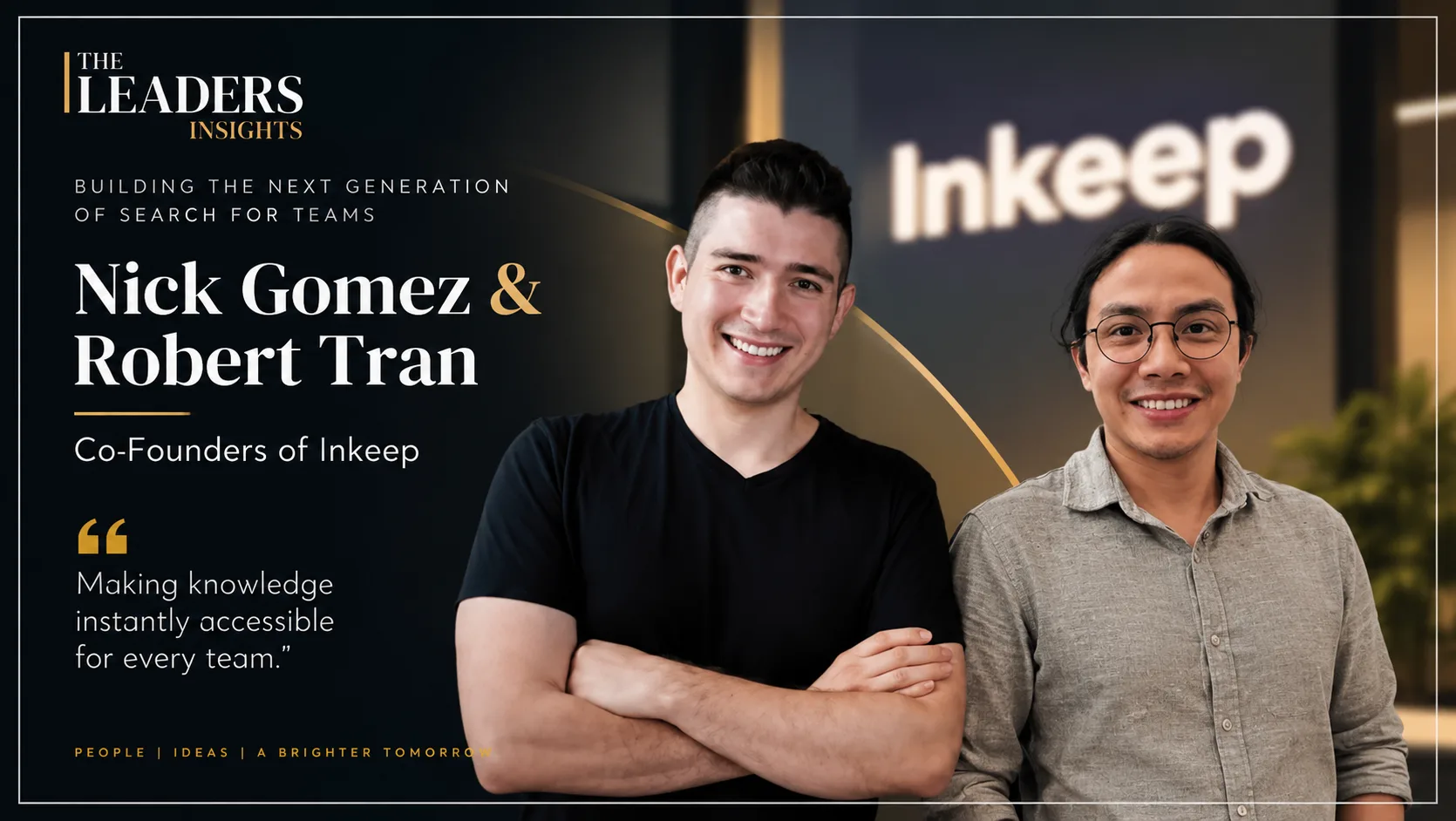
Nick Gomez and Robert Tran: Building Inkeep to Bring AI Agents Into Business Workflows
Businesses are experimenting with artificial intelligence, but many still face a practical challenge: how can they move from a helpful chatbot to AI that supports real work across a team? Inkeep, founded by Nick Gomez and Robert Tran, is building a platform designed to help companies answer that question.
The company’s focus has evolved. It began by helping technical businesses make their product documentation easier to search. Today, Inkeep offers tools that help teams build AI agents and connect them to business workflows. Its central idea is that engineers and nontechnical teams should be able to work together to create and manage these systems.
From developer questions to a wider business need
Inkeep joined Y Combinator’s Winter 2023 batch. Its first product focused on conversational search for developer products. The goal was to help developers find useful answers in technical documentation, GitHub issues, and other resources without having to search across multiple sites.
That focus grew from a problem the founders saw in technical support. Developers often need direct, practical answers while using a product. A generic chatbot may feel more like a sales channel than a useful source of help. Nick Gomez described the original idea as a way to offer answers that felt relevant to developers and grounded in a company’s technical content.
The early product also reflected the founders’ experience. Gomez previously worked on developer experiences at Microsoft, including identity products. Robert Tran studied computer science and mathematics at MIT and led engineering at illumis, where he worked on search and data systems. Their backgrounds brought together experience in developer tools, information retrieval, and software engineering.
As Inkeep worked with customers, the opportunity expanded beyond helping end users find documentation. Companies also needed a way for support teams to use AI while retaining control over customer interactions. Engineering teams could build sophisticated systems, but the people closest to support content and customer needs also wanted to shape how those systems worked. That feedback helped move Inkeep toward a broader platform for AI agents.
Why the company moved beyond search
Search is a useful starting point, but a business workflow often involves several steps. A support request, for example, may require finding relevant information, checking a customer’s account, drafting a response, and asking a person to approve it. A system that only retrieves an answer may not help with the rest of the task.
Inkeep’s current product direction reflects this wider view. The platform connects AI agents to company information and software tools. This helps them answer questions and, in some cases, complete tasks. The company’s website describes uses such as gathering context across customer systems, preparing responses for human approval, updating knowledge bases, and routing complex work to specialized agents.
The shift is not simply about making AI more autonomous. Inkeep presents agents as tools that can work alongside teams, with people involved in decisions that need review. That distinction matters in customer-facing work, where a fast answer is useful only if it is relevant, accurate, and appropriate for the situation.
One platform for technical and nontechnical teams
Inkeep offers a visual tool for building AI agents and a software development kit (SDK) for developers who prefer to use code. Teams can create agents through a no-code interface, while engineers can build and customize them in code. Inkeep says the two approaches stay in sync, allowing people with different roles to collaborate on the same agents and workflows.
This model addresses a common organizational gap. Engineers understand integrations, data access, and system reliability. Support, product, marketing, and sales teams understand the questions customers ask and the steps that make a process work. When those groups use disconnected tools, an AI project can become difficult to maintain or slow to adapt.
Inkeep’s examples show how its platform could connect work across teams. A support agent might answer common questions. A documentation agent could identify unanswered questions in support tickets and suggest updates to help content. A product team could use recurring customer questions to spot areas where users need more guidance. Sales teams could use agents to research or qualify leads. These are examples the company describes, not guaranteed outcomes for every business.
For developers, Inkeep highlights support for data connectors, tools, and the Model Context Protocol (MCP), a standard that helps AI systems connect with external tools and services. Its product materials also describe multi-agent workflows, in which a coordinator can assign parts of a task to more specialized agents.
Trust and oversight are part of the design
Business teams need more than an agent that can complete a task. They also need to understand what it did, test how it behaves, and decide when a person should step in. Inkeep says its platform includes testing, monitoring, and review features. Its funding announcement also states that agents are designed to indicate when they do not know or cannot help, while conversations can be labeled and analyzed for review.
These features address a common concern with business AI. Even a capable AI agent can pose risks if people cannot check what it does. In customer support, for instance, an incorrect answer can frustrate a customer. In internal operations, an unsupported action can create extra work or affect business records. Human approval and clear review paths can help teams introduce automation more carefully.
Inkeep’s earlier work on search also informs this emphasis. In a 2024 interview with Pinecone, Gomez discussed the importance of using relevant company content and handling different information sources appropriately. He described the process as iterative, with the team testing approaches against problems they encountered in real deployments.
Growth and the road ahead
In September 2025, Inkeep announced a $13 million seed round led by Khosla Ventures, GreatPoint Ventures, and Y Combinator. The company said the funding would support its goal of making AI agents accessible to customer-facing teams. Inkeep said its users include Anthropic, Midjourney, Pinecone, Clay, PostHog, and Solana.
That funding and customer list provide context for the company’s ambitions, but the broader market is still developing. Businesses need to determine which workflows are suitable for agents, how much autonomy to allow, and how to measure whether a system improves the experience for customers and employees. Connecting an agent to company data is only one part of that work; teams also need reliable processes for testing, monitoring, and updating it.
For Gomez and Tran, Inkeep’s development traces a path from a focused search product to a larger effort to bring AI into everyday business processes. The founders began by helping users find answers in technical content. They are now building tools intended to let the teams who create and support products design AI agents together.
The test for Inkeep, as for any company in this space, will be whether those agents become dependable parts of real workflows. If the platform can help businesses connect knowledge, tools, and human judgment in a way teams can manage, it may make AI useful beyond isolated chat windows—inside the work companies already need to get done.