From Challenge to Transformation: The Story of Sarah Franklin
Transformation rarely begins in comfort. It often begins at the edge of uncertainty, where leaders must move beyond what is familiar and step into roles that demand greater courage, discipline, and imagination.
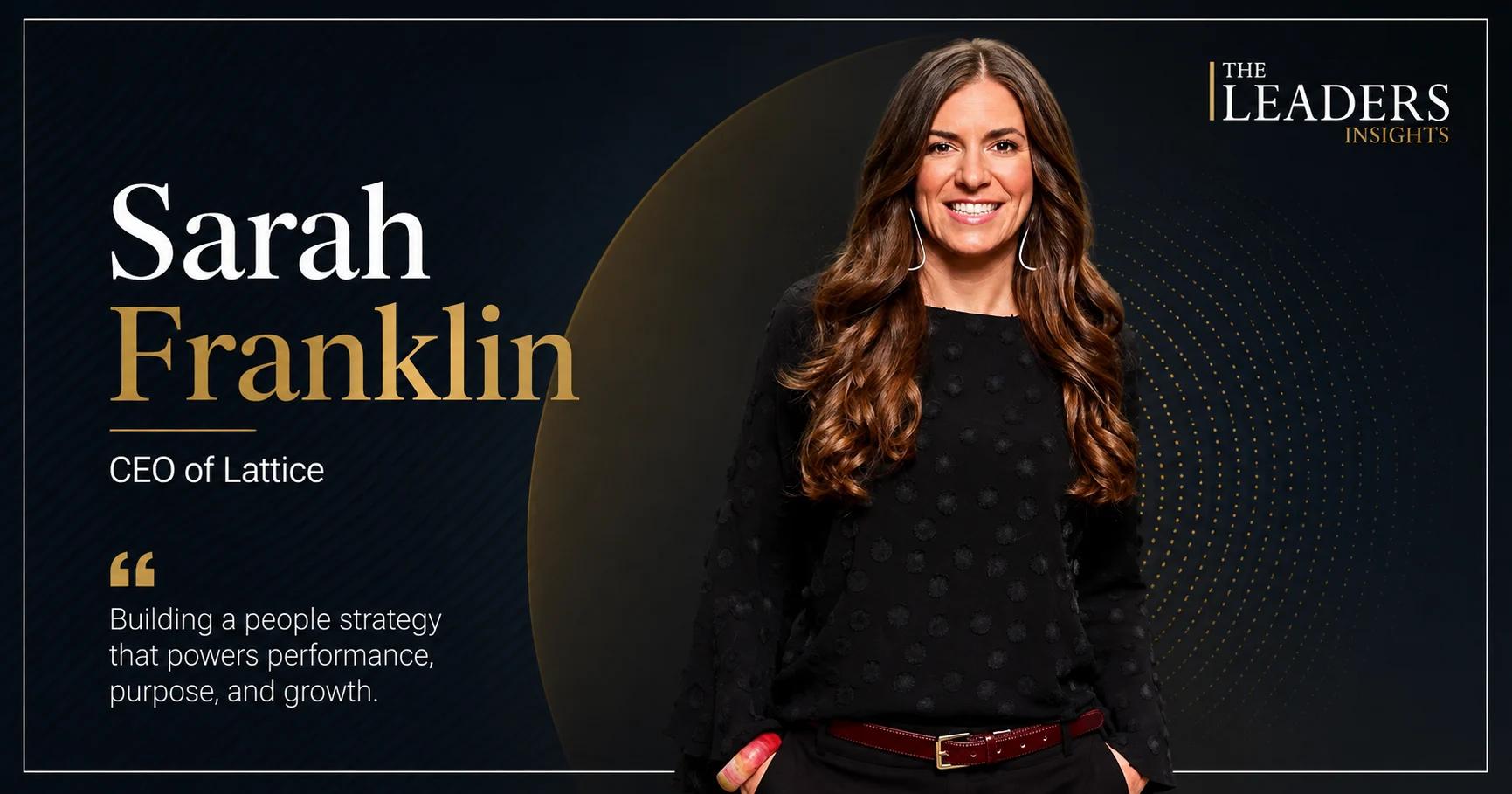
Sarah Franklin’s leadership journey reflects this kind of transition. As the CEO of Lattice and a former senior executive at Salesforce, Franklin represents a generation of American technology leaders who are not simply building companies but reshaping the way organizations think about people, work, culture, and the future of leadership.
Her story is not only about career advancement. It is about the ability to move from one chapter of influence to another without losing the deeper purpose behind the work. In a technology economy often dominated by speed, valuation, and disruption, Franklin’s leadership brings attention back to a question that matters deeply for CEOs, founders, university leaders, healthcare executives, and institutional decision-makers: How do leaders transform organizations while keeping people at the center?
Transformation Begins with the Willingness to Step Into the Unknown
Leadership growth often requires leaving a place of achievement for a place of greater responsibility. For Franklin, moving from Salesforce, one of the most influential technology companies in the United States, into the CEO role at Lattice was more than a professional move. It represented a shift from leading within a global enterprise to guiding a company through its next stage of maturity.
That kind of transition requires more than experience. It requires the confidence to enter a new environment, earn trust quickly, understand the culture, and set direction without dismissing what already exists.
Great leaders do not transform organizations by arriving with a desire to replace everything. They begin by listening. They study the people, the product, the market, the customers, and the internal rhythms. Then they identify where the organization must evolve to meet the future.
This is where Franklin’s leadership story becomes relevant beyond the technology sector. Every institution eventually reaches a point where its past success is no longer enough to guarantee future relevance. Universities must adapt to new learning models. Healthcare systems must redesign care delivery. Companies must rethink how talent, technology, and culture intersect.
Transformation begins when a leader is willing to ask what the next version of the institution must become.
People-Centered Leadership in an AI-Driven Workplace
The future of work is being shaped by artificial intelligence, automation, distributed teams, and changing expectations around the employee experience. In this environment, many organizations are tempted to view technology mainly through the lens of efficiency. They ask how AI can reduce costs, accelerate output, or replace repetitive tasks.
Franklin’s leadership offers a more balanced perspective. The deeper question is not only what technology can do, but what it should do in the service of people.
This distinction matters. In the United States, where companies are under pressure to adopt AI quickly, leaders must avoid treating workers as secondary to systems. Technology may improve workflows, but culture determines whether people trust it. AI may increase productivity, but leadership determines whether employees feel empowered or replaced. Digital tools may create new possibilities, but human judgment remains essential.
For CEOs and CXOs, this is one of the defining leadership challenges of the next decade. The organizations that succeed will not be those that simply deploy the most advanced tools. They will be those who connect technology to human capability, organizational trust, and meaningful work.
Franklin’s story reflects this shift from technology adoption to technology stewardship. The leader’s role is no longer only to approve innovation. It is to shape the conditions under which innovation strengthens people rather than diminishing them.
Turning Challenge Into Strategic Clarity
Every transformation journey includes moments of challenge. For leaders in highly visible roles, decisions are examined by employees, customers, investors, media, and industry observers. Missteps, criticism, and public debate can become part of the leadership experience.
What separates transformative leaders from reactive leaders is how they respond.
A challenge can become a defensive moment or a moment of strategic clarity. Leaders who are willing to engage with difficult feedback often build stronger organizations. They refine language. They sharpen priorities. They clarify values. They learn how the market, employees, and stakeholders are interpreting change.
Franklin’s leadership at Lattice has unfolded during a time when AI and the workforce are central to national business conversations. Questions around digital abouts, employee experience, AI governance, and human accountability are no longer theoretical, but boardroom issues.
In this context, challenge becomes part of transformation. A leader cannot guide a company through the future of work without encountering tension. The important thing is not the absence of tension. It is the ability to convert tension into learning, governance, and better decision-making.
Redefining Executive Leadership for the Modern Workplace
The modern executive role is changing. Leaders are expected to understand technology, culture, brand, operations, ethics, and human behavior. They must communicate across internal teams and external markets. They must move quickly, but not carelessly. They must inspire confidence without pretending to have an answer.
Franklin’s career reflects this multidimensional leadership model. Her background combines product understanding, marketing discipline, business strategy, and people-centered thinking. That blend is increasingly valuable in a marketplace where leadership cannot remain siloed.
A CEO today must understand the product, as well as the story behind it. They must understand customers, but also employees. They must understand growth, but also trust. They must understand technology, but also the emotional and cultural impact of change.
This is especially important for American companies competing in global markets. The strongest leaders are not only operators. They are translators. They translate complexity into direction. They translate technology into value. They translate vision into culture.
Real-World Perspective: The Future of Work Needs Human Leadership
Across the United States, organizations are trying to answer a difficult question: What should work look like in an era of AI?
Some companies are focused on automation. Others are focused on productivity. Many are still trying to understand how AI will affect hiring, management, performance, training, and employee trust. The conversation is moving faster than the playbook.
This is where leaders like Franklin become important. Her role sits at the intersection of technology and human capital, two forces that will define the next generation of organizational success.
The future of work will not be shaped by software platforms alone. It will also depend on the leadership decisions organizations make today. Companies will need to decide how they measure performance, how they support managers, develop talent, govern AI, and preserve human dignity in increasingly digital workplaces.
For healthcare executives, this may mean using technology to support clinicians without deepening burnout. For university leaders, it may mean preparing students for careers where AI is a collaborator, not just a tool. For founders, it may mean building companies where speed does not come at the cost of culture.
The future demands leaders who can see both the system and the person inside it.
A Forward-Looking View of Transformational Leadership
Sarah Franklin’s story is ultimately a story of movement: from technical foundation to executive influence, from enterprise leadership to CEO responsibility, from personal achievement to broader transformation.
Her leadership reflects a larger shift taking place across the American business landscape. The next generation of respected leaders will not be defined only by growth metrics or market visibility. They will be defined by their ability to guide organizations through change while protecting the human purpose behind the work.
Transformation is not simply about becoming bigger, faster, or more technologically advanced. It is about becoming more prepared for the future, more aligned with values, and more capable of earning trust.
In a time when every institution is being challenged to rethink how it operates, Franklin’s journey offers a powerful reminder: leadership is not proven by avoiding complexity. It is proven by moving through complexity with clarity, accountability, and conviction.
The leaders who shape the future will be those who can turn challenge into direction, uncertainty into learning, and transformation into lasting institutional strength.