
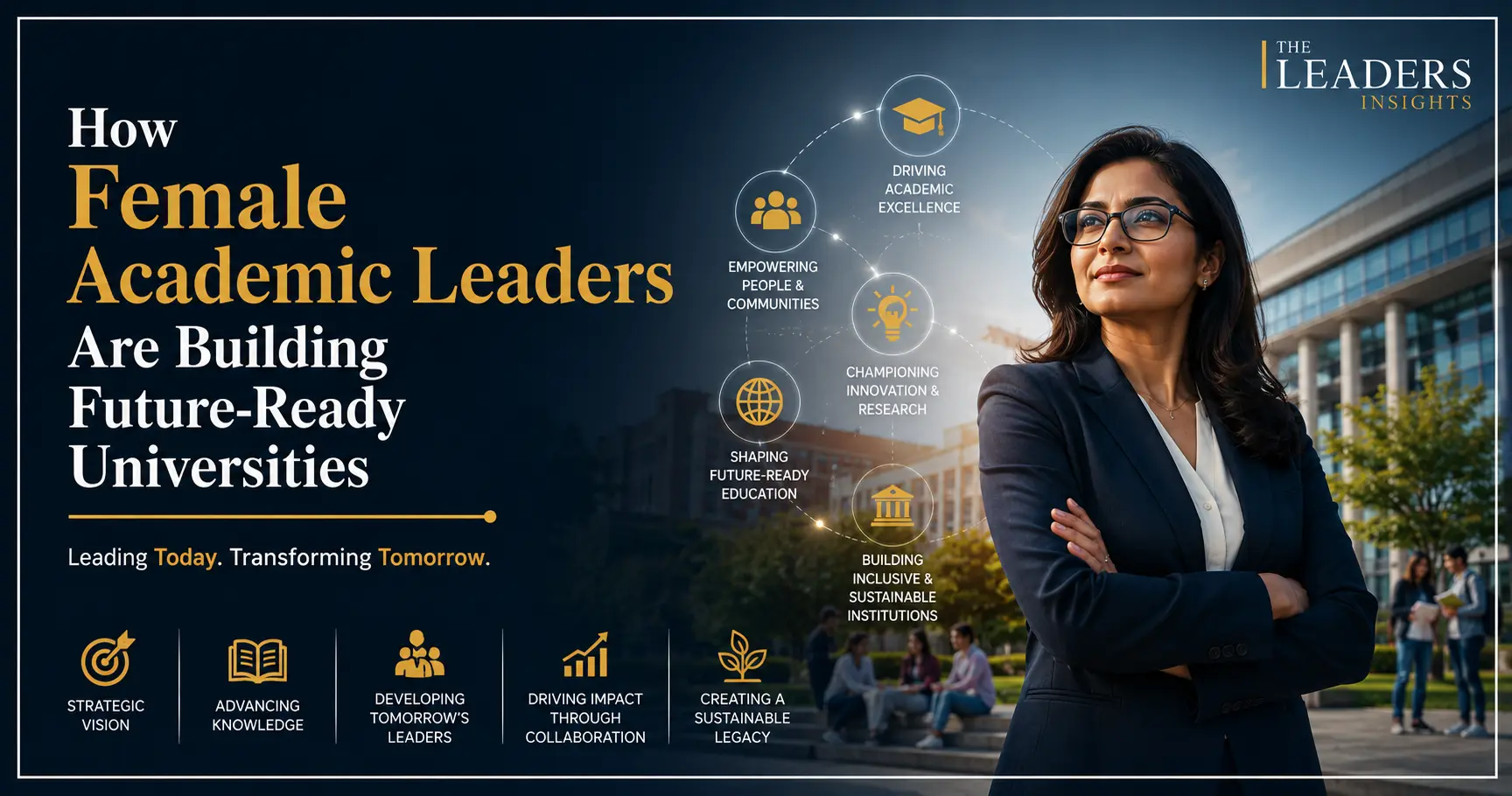
How Female Academic Leaders Are Building Future-Ready Universities
The future of higher education in the United States is being shaped in a period of profound institutional change. Universities are navigating shifting enrollment patterns, rising questions about affordability, evolving workforce expectations, technological disruption, political scrutiny, and the growing demand for measurable public value. In this environment, leadership is no longer defined only by tradition, academic reputation, or administrative experience. It is defined by the ability to reimagine the university as a resilient, inclusive, globally relevant institution.
Across American higher education, female academic leaders are playing a powerful role in this transformation. As university presidents, provosts, deans, researchers, board members, and institutional strategists, women are helping redefine what future-ready universities must become.
Their influence goes beyond representation. Female academic leaders are bringing strategic clarity to complex institutions, strengthening student-centered models, advancing research relevance, and building cultures that are better prepared for the next generation of learners.
Leading Universities Through a New Era of Complexity
The modern university is no longer operating in a predictable academic environment. Higher education leaders must respond to rapid changes in technology, workforce demands, demographic trends, funding pressures, and public expectations. The question facing universities is not simply how to preserve academic excellence, but how to make that excellence meaningful in a changing world.
Female academic leaders are increasingly leading through this complexity with a balanced understanding of tradition and transformation. They recognize that universities must protect the integrity of scholarship while also adapting to the realities of modern learners, employers, communities, and global partners.
This requires leadership that can work across multiple dimensions. A university president must engage trustees, faculty, students, alumni, government stakeholders, donors, employers, and the broader public. A dean must think about academic quality, research impact, faculty development, student outcomes, and financial sustainability. A provost must balance intellectual mission with institutional strategy.
Female leaders in higher education are demonstrating that future-ready leadership is not about abandoning the university’s historic purpose. It is about ensuring that purpose remains relevant, accessible, and trusted.
Building Student-Centered Institutions
One of the most important shifts in American higher education is the move from institution-centered thinking to student-centered strategy. Students today are asking different questions than previous generations. They want to know whether their education will prepare them for meaningful careers, whether the institution understands their realities, and whether the value of the degree is clear.
Female academic leaders are helping universities respond to these expectations with greater intention.
This includes strengthening student success programs, improving advising systems, expanding access for nontraditional learners, supporting mental health, and building stronger pathways between education and employment. The future-ready university cannot treat student support as a secondary function. It must see student success as a central measure of institutional excellence.
This approach is especially important in the United States, where higher education is closely connected to social mobility, workforce development, and economic competitiveness. Universities that fail to support students beyond enrollment risk losing public confidence. Universities that build stronger student-centered models are more likely to earn long-term trust.
Female academic leaders often bring a deep awareness of the human side of institutional performance. They understand that retention, graduation, belonging, and career readiness are not separate from academic quality. They are part of how academic quality is experienced.
Advancing Innovation Without Losing Institutional Trust
Technology is reshaping higher education at every level. Artificial intelligence, digital learning platforms, data analytics, virtual research collaboration, and new credential models are changing how universities teach, operate, and compete. Yet innovation in higher education must be handled carefully. Universities are not ordinary organizations. They carry public responsibility, intellectual credibility, and long-term social influence.
Female academic leaders are helping institutions adopt innovation with thoughtful governance and ethical clarity.
A future-ready university must explore new technologies, but it must also ask deeper questions. How should AI be used in teaching and research? How can digital platforms improve access without weakening academic rigor? How can data support student success while protecting privacy? How can universities prepare graduates for industries (that are changing faster than traditional curricula)?
These questions require leaders who are not distracted by technology for its own sake. They require leaders who can connect innovation to mission.
The strongest academic leaders understand that universities must be both progressive and principled. They must experiment, but not recklessly. They must modernize, but not dilute trust. Female leaders are increasingly central to this balance, guiding universities toward innovation that serves students, faculty, research, and society.
Creating Cultures of Inclusion, Excellence, and Accountability
Future-ready universities will not be built only through new programs or digital infrastructure. They will be built through culture.
Academic institutions are complex communities. They depend on faculty excellence, student engagement, staff commitment, alumni trust, and public credibility. Culture determines whether a university can adapt or be trapped in internal silos.
Female academic leaders are helping strengthen institutional cultures that combine inclusion with excellence and accountability. They are expanding the idea of who belongs in academic leadership, whose voices are heard in decision-making, and how institutions support talent at every level.
This is not simply a matter of language diversity. It is a strategic issue. Universities that attract and retain diverse faculty, students, researchers, and administrators are better positioned to address complex problems. They are more likely to produce relevant research, build global partnerships, and prepare graduates for diverse workplaces and societies.
At the same time, strong female academic leaders understand that inclusion must be connected to performance. A future-ready university must be welcoming, but also rigorous. It must be compassionate, but also accountable. It must create opportunity while maintaining high standards.
This combination is essential for institutional credibility.
Real-World Perspective: Universities Are Being Asked to Prove Their Value
Across the United States, universities are facing a new level of public evaluation. Families are questioning costs. Employers are questioning skills. Communities are questioning relevance. Policymakers are questioning outcomes. Students are questioning whether traditional models match their future.
Female academic leaders are stepping into this moment with a broader vision of institutional value.
They are helping universities connect academic programs to real-world challenges. They are strengthening partnerships with industry, healthcare systems, civic organizations, and global research networks. They are expanding interdisciplinary learning and encouraging collaboration across fields that once operated separately.
In healthcare education, women leaders are helping prepare professionals for systems shaped by technology, equity, and patient-centered care. In business schools, women leaders are helping shape leadership models that focus on ethics, sustainability, and global responsibility. In STEM and research universities, they are supporting innovation ecosystems that connect discovery with societal impact.
The most effective leaders are not defending higher education through tradition alone. They are demonstrating why universities remain essential to the country.
The Future University Will Need Transformational Leadership
The next generation of universities will be judged by their ability to prepare students for uncertain futures, produce research that matters, strengthen communities, and maintain trust in an era of disruption. This will require leaders who can think institutionally, act strategically, and lead with human understanding.
Female academic leaders are already helping build this future.
They are showing that university leadership must be both visionary and practical. It must honor academic heritage while embracing necessary change. It must protect intellectual freedom while responding to public expectations. It must invest in innovation while preserving trust.
For CEOs, founders, healthcare executives, and institutional leaders outside academia, this transformation carries a broader lesson. Future-ready institutions are not built by maintaining systems exactly as they are. They are built by leaders who understand when to protect, when to challenge, and when to redesign.
Their leadership is shaping universities that are more adaptive, inclusive, accountable, and connected. In doing so, they are strengthening the role of higher education as one of America’s most important engines of progress.