
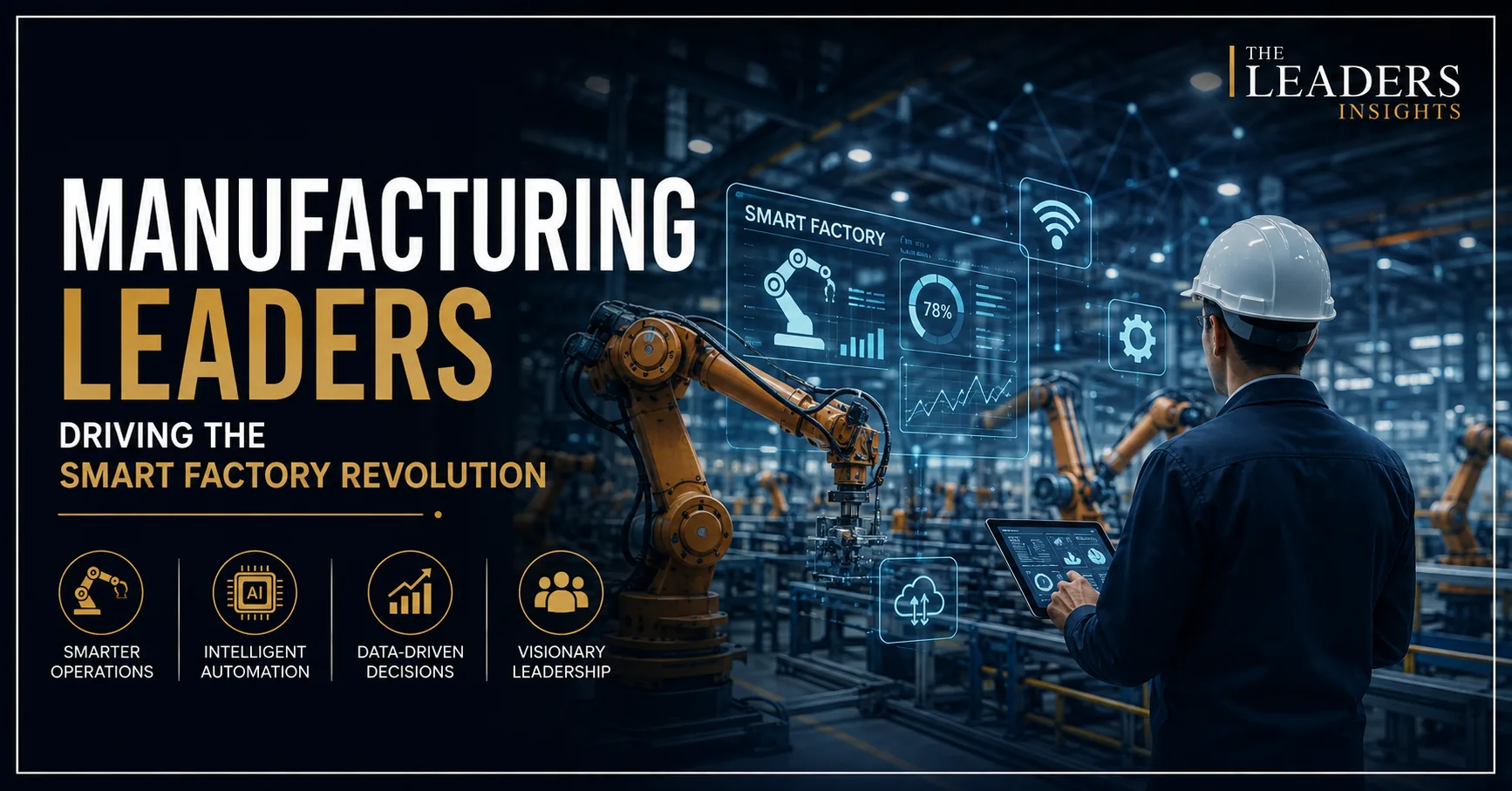
Manufacturing Leaders Driving the Smart Factory Revolution
For decades, the image of American manufacturing was defined by sparks, heavy iron, manual assembly lines, and the rhythmic clatter of mechanical machinery. That image is now undergoing its most radical transformation in over a century.
We are living in the era of the Smart Factory – an ecosystem where physical machines, software systems, and human workers communicate in real time. Known as Industry 4.0, this shift is powered by artificial intelligence, the Industrial Internet of Things (IIoT), predictive analytics, and autonomous robotics.
Behind this revolution are forward-thinking manufacturing leaders who recognize that staying competitive on global soil requires more than just making things faster. It requires making things smarter.
What Is a Smart Factory? (And Why Now?)
At its core, a smart factory replaces guesswork with operational visibility.
Traditional factories operate in silos: a machine breaks down, a supervisor notices the pause, maintenance gets called, and production stops until someone diagnoses the issue. A smart factory flips this model.
Sensors embedded inside machines continuously track vibration, heat, operational load, and throughput. AI models analyze this data to identify possible equipment problems weeks in advance. This gives technicians time to fix issues and helps companies adjust production schedules before a breakdown occurs.
The Core Tech Stack Driving Smart Factories:
- – Industrial Internet of Things (IIoT): Sensors attached to equipment that collect and transmit real-time data.
- – Artificial Intelligence & Machine Learning: AI algorithms that inspect product quality, optimize energy usage, and automate complex tasks.
- – Digital Twins: Virtual 3D replicas of physical equipment or entire plants used to simulate operational changes before rolling them out on the floor.
- – Cobots (Collaborative Robots): Modern, safe robotic arms designed to work alongside human operators rather than inside fenced cages.
How Modern Leaders Are Leading the Transformation
Building a smart factory isn’t just about buying expensive software or fancy machines; it’s a fundamental shift in leadership philosophy. The executives successfully steering their plants into the future follow three core principles:
1. Moving from Reactivity to Predictive Control
Traditional manufacturing management focuses on firefighting—solving problems after they disrupt the line. Smart factory leaders prioritize predictive workflows. By relying on machine metrics and real-time dashboards, floor managers address bottlenecks, supply disruptions, and equipment degradation proactively rather than reactively.
2. Upskilling the Workforce (Humans + Automation)
One of the largest misconceptions about the smart factory revolution is that automation replaces people. In reality, modern smart plants face a labor shortage.
Leading executives treat technology as an empowerment tool. Instead of spending hours performing repetitive physical checks or manual data entry, shop floor workers are trained to act as system operators, data interpreters, and process optimizers.
Key Insight: Automation handles the monotonous, high-danger tasks, freeing human ingenuity for creative problem-solving and quality refinement.
3. Scaling Micro-Pilots into Floor-Wide Systems
Many manufacturers get stuck in “pilot paralysis”—testing smart sensors on a single machine without ever rolling out the system company-wide. Successful leaders pick one concrete problem first (e.g., reducing scrap rates on line #2 or curbing unplanned downtime), solve it with connected tech, prove the return on investment (ROI), and then scale the framework across plants.
The Key Benefits Reshaping US Manufacturing
The financial and operational incentives driving American leaders to adopt smart factory models are massive:
| Operational Metric | Traditional Factory | Smart Factory |
| Downtime | Reactive (Fix when broken) | Predictive (Fix during scheduled intervals) |
| Quality Control | Manual end-of-line inspections | AI vision systems inspecting every millisecond |
| Energy Consumption | Static, unmonitored baseline | Dynamic power scaling based on production loads |
| Supply Chain Response | Days to adjust to inventory shifts | Real-time automated adjustments across systems |
Navigating the Challenges of Smart Manufacturing
While the benefits are clear, the transformation isn’t without its hurdles. Leaders driving Industry 4.0 initiatives regularly navigate three core challenges:
- Cybersecurity Risks: Connecting legacy plant equipment to local cloud networks opens new attack vectors. Smart manufacturing leaders work closely with IT and OT (Operational Technology) teams to lock down plant networks.
- Integrating Legacy Equipment: Many factories use older machines that work well. Companies can add IoT devices to these machines instead of replacing them. This helps factories use modern technology while saving the cost of buying new equipment.
- Cultural Resistance: Change can be intimidating for shop-floor veterans who have operated the same way for decades. Leaders build trust by involving machine operators early in tech evaluations, showing them how new tools make their jobs easier and safer.
Summary
The smart factory revolution is no longer a futuristic concept; it is the present standard for competitive manufacturing. The leaders thriving in this new industrial landscape are those who combine connected technology with human-centric leadership. By turning data into action, upskilling their teams, and starting with focused ROI-driven goals, executive leaders are proving that the future of manufacturing is bright, agile, and remarkably smart.