
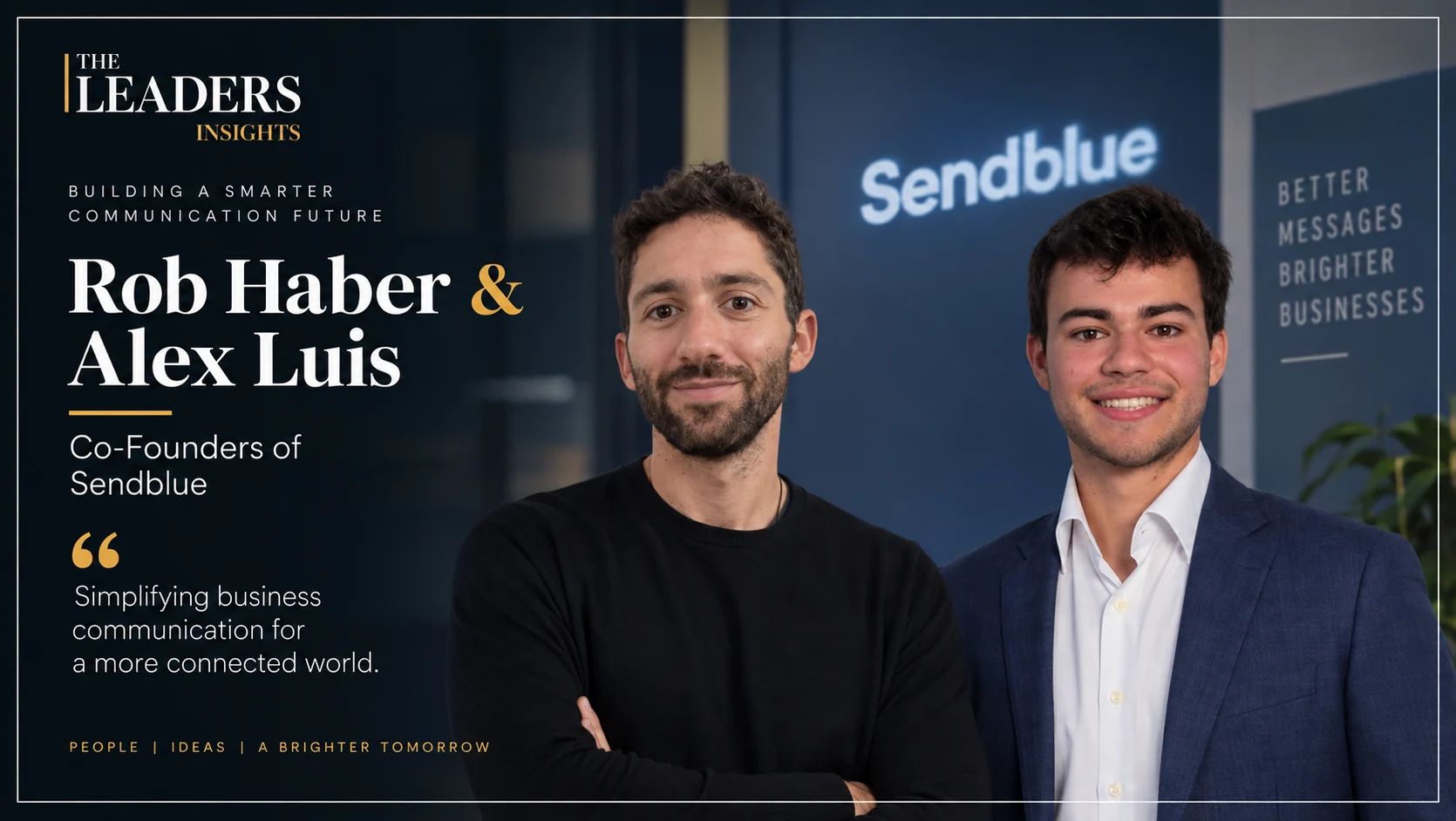
How Rob Haber and Alex Luis Are Helping Sales Teams Drive High-Response Revenue Conversations With Sendblue
For many sales organizations, reaching a qualified prospect has become harder than identifying one. Buyers often overlook sales messages because their inboxes are crowded, calls from unknown numbers go unanswered, and generic outreach fails to capture their attention. The challenge is no longer simply finding another communication channel. Companies need a way to begin relevant conversations without making customers feel as though they have entered an automated campaign.
Sendblue is addressing that challenge by bringing iMessage into business sales workflows. Founded by Rob Haber and Alex Luis, the New York-based company enables organizations to contact prospects through virtual iMessage lines, manage replies, connect conversations with existing software, and automate appropriate follow-ups.
Its broader proposition is straightforward: sales communication should take place where customers are already comfortable responding. Yet Sendblue’s story also reveals something important for business leaders. Strong results do not come from the channel alone. They depend on timing, context, disciplined execution, and respect for the person receiving the message.
A Founder Combination Built Around Technology and Customer Experience
Haber and Luis bring complementary backgrounds to the company. According to Y Combinator’s Sendblue profile, Haber previously worked as a machine-learning engineer at Scale AI and earned a master’s degree in artificial intelligence from Carnegie Mellon University. His earlier experience included roles at Amazon and Regeneron.
Luis worked as a product manager and consultant in PwC’s telecommunications practice, where he gained exposure to technologies such as 5G and the Internet of Things. While Haber contributed deep technical knowledge, Luis brought experience in telecommunications, product development, and customer service.
The two founders had known each other since meeting on their high school tennis team. That long relationship gave them a foundation, but their startup idea continued to develop after the company was formed.
Sendblue participated in Y Combinator’s Summer 2023 batch. Its directory page retains information from an earlier product called Raz, which used conversational artificial intelligence to make forms more interactive. The current business focuses on iMessage infrastructure for sales teams and developers. That evolution reflects a valuable entrepreneurial skill: recognizing when an underlying capability has greater potential than its original application.
Instead of limiting conversational technology to surveys and forms, Haber and Luis moved toward a larger commercial problem—helping businesses hold direct, two-way discussions with prospects and customers.
Moving Business Messaging Beyond Traditional SMS
Conventional SMS remains useful for confirmations, alerts, and short notifications. However, it does not always offer the experience that sales representatives want when building relationships.
Sendblue allows businesses to send and receive iMessages programmatically from dedicated phone numbers. When the recipient has iMessage enabled, the conversation can include familiar features such as blue bubbles, typing indicators, read receipts, reactions, and high-quality media. If iMessage is unavailable, Sendblue says its system can fall back to RCS and then SMS.
That distinction matters because a sales exchange is rarely just a notification. A representative may need to answer a question, share a short video, confirm a meeting, introduce another colleague, or continue a discussion over several days. The interaction has to feel coherent on both sides.
Sendblue also provides a shared inbox, allowing authorized team members to view and manage conversations without depending on an employee’s personal phone. This can improve continuity when accounts change hands, a representative is unavailable, or managers need visibility into customer engagement.
What happens when a prospect replies after the assigned salesperson has finished work for the day? A shared system gives the organization a better chance of responding while the buyer’s interest is still active.
Connecting Conversations With Revenue Workflows
A messaging product becomes more valuable when it works with the systems that sales teams already use. Sendblue lists connections with platforms such as Salesforce, HubSpot, HighLevel, Close, Zapier, Make, and Monday.com on its integrations page.
These connections can help companies coordinate outreach with actual customer activity. A message might be triggered after someone requests a demonstration, misses a scheduled call, completes an application, or reaches a particular stage in the sales pipeline. Customer responses can be stored in the company’s CRM, where the entire team can access them, rather than being kept on one representative’s phone.
This creates a more complete view of the buyer journey. A sales manager can see whether a lead received a message, responded, booked a meeting, or required additional attention. Representatives spend less time moving information between systems and more time handling conversations that may influence revenue.
Automation can also bring consistency to routine steps. For example, a workflow could remind a prospect about an upcoming demonstration and notify the account owner when the person replies. The technology handles the operational handoff while the representative takes responsibility for the discussion.
That balance is essential. Automation should create a timely opening for human engagement, not overwhelm customers with artificial exchanges.
Designing Outreach That Invites a Response
Sendblue’s Y Combinator profile says its users see an average 70% increase in response rates. Because this is a company-reported figure rather than an independently audited industry benchmark, leaders should evaluate it in the context of their own sales process.
Still, the claim points toward a practical principle. People are more likely to respond when a message is brief, relevant, recognizable, and easy to act upon. A well-timed note confirming interest in a requested demonstration is very different from an unsolicited promotional blast.
Sendblue does not support mass messaging because it can generate spam and damage the reputation. The platform also places limits on the number of contacts that can be reached daily from each line. These controls reinforce its focus on conversation rather than indiscriminate volume.
For sales leaders, this should shape implementation. Teams need to define who may be contacted, why the message is appropriate, and what information the recipient has already provided. They should also establish clear standards for introductions, follow-up frequency, response times, and escalation.
Would a representative feel comfortable sending the same message personally to a valued prospect? If not, automation does not make it better.
Adding AI Without Removing Judgment
Sendblue offers AI-assisted follow-up tools and an API that allows developers to build automated messaging agents. Its website describes workflows in which software can send messages, process replies, and take actions based on conversational context.
These capabilities can support several sales tasks. AI may help draft follow-ups, classify responses, identify buying signals, summarize discussions, or route questions to the right employee. It can also help ensure that routine inquiries receive prompt attention.
However, senior leaders should define limits before expanding automated communication. Pricing discussions, contractual questions, complaints, sensitive personal information, and unusual requests may require immediate human review. Customers should not be led to believe they are speaking with a person when the interaction is entirely automated.
Good governance requires more than selecting an AI model. Organizations need rules for data access, quality checks, staff accountability, and escalation. They should review conversation samples regularly and measure whether automation improves the customer experience—not merely whether it increases message volume.
Compliance Must Be Part of the Sales Strategy
Even though customers are familiar with iMessage, companies must still follow all applicable laws and regulations when using it. In the United States, business texting may be subject to the Telephone Consumer Protection Act, Federal Communications Commission rules, state requirements, and industry standards.
The FCC’s consumer guidance on unwanted calls and texts explains that certain telemarketing communications require prior written consent. Requirements can vary according to the technology, purpose, relationship, and method used to send a message. Businesses should obtain qualified legal advice for their specific use case.
Teams also need reliable processes for recording consent, identifying the sender, honoring opt-out requests, restricting access, and retaining data appropriately. Sendblue says that it is SOC 2 Type II certified and offers plans designed to support HIPAA-related requirements. Buyers should still conduct their own security and compliance assessments rather than treating a vendor credential as a complete risk program.
Trust is particularly important in a personal channel. One irrelevant message can damage a relationship that took months to develop.
Measuring Conversations, Not Just Activity
Traditional sales dashboards often emphasize calls placed, emails sent, or total touches. Messaging requires a more thoughtful set of indicators.
Leaders can examine reply rates, positive-response rates, meetings booked, time to first response, pipeline progression, opt-outs, and customer complaints. They should compare results across customer segments and outreach situations.
The quality of the conversation also matters. A campaign may produce many replies but little qualified interest. Another may reach fewer people while generating stronger opportunities. Revenue teams need to connect messaging activity with conversion, retention, and customer satisfaction to understand its real contribution.
A Leadership Lesson in Meeting Customers Where They Are
Haber and Luis are building Sendblue around a simple observation: communication infrastructure affects commercial performance. When outreach feels disconnected from how people communicate in daily life, even good offers can be overlooked.
Their approach gives sales teams a way to combine iMessage, CRM data, shared visibility, workflow automation, and AI-assisted engagement. The result is not a replacement for skilled representatives. It is infrastructure that can help those employees respond sooner and maintain more organized conversations.
For CEOs and revenue leaders, the opportunity is larger than adding another sales tool. It is a chance to reconsider how their organizations earn attention. The strongest outreach does not interrupt people with greater force. It arrives with a clear purpose, makes responding easy, and creates a natural path toward a useful discussion.
Sendblue’s long-term impact will depend on how responsibly companies use that access. When consent, relevance, technology, and human judgment work together, messaging can become more than another outbound channel. It can serve as the beginning of a trusted revenue relationship.