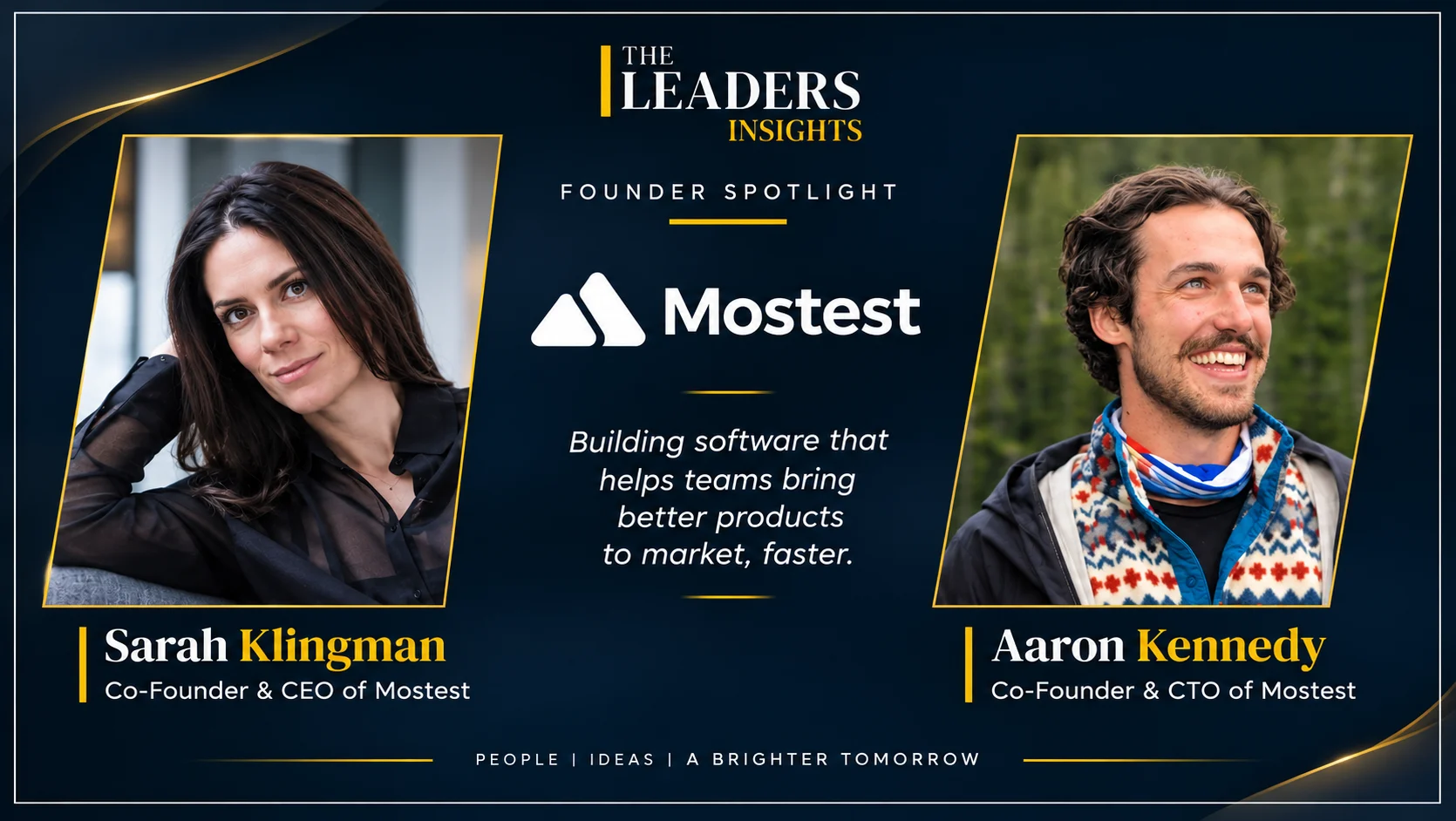
Sarah Klingman and Aaron Kennedy: Rethinking the Future of Event Booking
Sarah Klingman saw how much work went into booking even a small corporate event. With Aaron Kennedy as co-founder and CTO, Mostest is building technology around that work while continuing to offer professional planning and on-site coordination.
Imagine you’re organizing a dinner for 35 clients. The first restaurant has the date available, but its private room seats 30. The second option can accommodate all your guests, and staffing costs are separate. The third option needs your final guest count before it can send you a menu. By the time you have three proposals you can compare, you’ve spent a week answering variations of the same questions. You still need someone to approve the budget.
Sarah Klingman recognized that problem while working at Adidas. Some of the events she helped organize fell within the company’s dedicated events team. Others landed with people who already had a full-time job. She later founded Mostest, a New York City company that helps clients plan and book events. Aaron Kennedy later joined as co-founder and chief technology officer as the company expanded its work on software for hosts, venues, and event professionals.
The Events That Fell Outside the Events Team
On The Hard Launch podcast, Klingman recalled that Adidas had an events team, but its scope varied depending on what different parts of the business were doing. When an event fell outside that scope, arranging it could take time away from the work she was expected to deliver. She saw room for a service that could help someone book part of an event or get professional guidance without commissioning a full production.
Klingman tested the idea by doing the work herself. She started planning and coordinating weddings alongside her full-time job. That put her in a position to see where people needed help in practice. She could observe which decisions clients wanted to make themselves, which they were happy to hand over, and how often a straightforward request led to several rounds of follow-up.
Mostest now offers different levels of support. A host can hire a planner for specific work, such as developing an event concept or finding and booking vendors.
What Kennedy Brought to Mostest
When Klingman announced Kennedy’s appointment, she said she had known him for several years and described him as a repeat founder with experience building applied AI systems. Mostest lists her as CEO and Kennedy as CTO. The sequence matters to the story. When Kennedy joined, the company was already helping clients plan events. Kennedy’s role was to help the company expand.
The technology challenge becomes clearer when you look at a single venue inquiry. A host describes a private dinner for 35 people, but a venue needs to know whether that means a seated meal or a reception with guests standing. A budget may cover the room and food, or it may also have to cover drinks, service, and equipment. A room that looks like a good fit can drop off the list as soon as those details become clear.
For a product team, that means a good event brief needs to do two jobs. It needs to capture what the host wants in language they would naturally use. It also needs to give venues and vendors enough information to respond with something the host can act on. The better the system handles that exchange, the fewer times someone has to pick up the phone to find out what a quote actually includes.
How Mostest’s AI Planning Tool Works
Mostest describes its AI Planning product as a self-service tool in beta in New York City. A host can enter the event’s date, guest count, budget, and style in plain language. The tool turns that description into a working plan, recommends venues and vendors, and gives the host a place to compare and book options. According to Mostest, the tool helps planners set the timing and order of activities on the day of the event. Hosts can use it alongside a professional planner or coordinator.
Think of a founder planning a reception for customers after a product launch. They might ask for a space near the launch venue, enough room for 60 people, and a setup that allows for a short presentation. A useful plan can narrow the search and give the founder a clearer basis for comparing options. The founder still gets to decide whether the room makes sense for the conversations they want guests to have.
The venue has its own version of the problem. Capital Q Ventures, an investor in Mostest, describes the company’s offering for hotels, restaurants, and hospitality groups as a way to manage inquiries and generate proposals. For a restaurant manager, the software would show up in the quality of the requests it brings in. An inquiry with a date, a realistic guest count, and a clear idea of the service required is easier to answer than a message that simply asks what a private event costs.
A Nike Dinner Shows What Happens After the Booking
Mostest’s work with Nike offers a view of the services side of the business. According to a case study (published by Mostest), the company helped design and coordinate a private dinner for about 35 Nike brand leaders and executives at Suprema in New York City during the FIFA World Cup. The aim was to give guests a setting for conversation away from the wider schedule of activities. Mostest says it managed creative direction, vendor communication, venue coordination, timing, setup, and on-site execution.
Those details explain why a booking confirmation marks only one stage of the work. A venue can be secured while decisions about setup, timing, and the guest experience are still open. On the day itself, someone has to know when vendors can enter, whether the room is ready, and what to do if the schedule changes. For the Nike dinner, Mostest describes that responsibility as part of its design and coordination work.
For a CEO or managing director planning an executive gathering, the example offers a concrete way to think about the budget. The room, menu, and equipment are easy to list. The time needed to coordinate them is harder to see until the work lands on someone’s calendar. Deciding who owns that work is part of deciding what the company is buying.
What the $4 Million Seed Round Will Support
On October 27, 2026, Capital Q Ventures announced that Mostest had raised $4 million in seed funding. Capital Q Ventures, NEXUS Luxury Collection, and T-Squared Social led the round. The announcement said the funding would support technology development, hospitality partnerships, and expansion in corporate and private events.
Growing the venue network raises a question that goes beyond adding more listings. Can a host get an accurate answer about a particular room on a particular date? A hotel with several event spaces may have different menus, staffing requirements, and room layouts for each one. When that information changes, the booking experience depends on how quickly the venue and the platform can reflect it.
The board could track how many qualified inquiries turn into confirmed bookings and how often customers return to plan another event. It could also measure how much time staff spend resolving booking issues. Together, these figures could help the board assess whether the software makes booking easier for both hosts and venues.
Klingman’s original question came from an ordinary assignment inside a large company. Who helps when someone needs to organize an event and already has a job to do? Mostest’s answer now ranges from a tool that turns a short brief into a plan to a coordinator who is there when the doors open. The company’s next test is whether that flexibility still works as it handles more events, more venues, and more decisions that have to be made right before guests arrive.
Share Your Leadership Story With The Leaders Insights
What recurring problem did your team decide was worth building a business around? Maybe it started with a task that kept landing on the wrong person’s desk, a customer request no one could answer easily, or a process that worked at ten customers and broke at a hundred.
The Leaders Insights invites U.S.-based founders, CEOs, managing directors, senior managers, and board members to share the decisions behind their work. Tell us what you noticed, how you tested your idea, and what changed when people started using it. Your experience could become a feature that gives other leaders a practical example to draw from.
Apply to be featured on The Leaders Insights or nominate a leader.