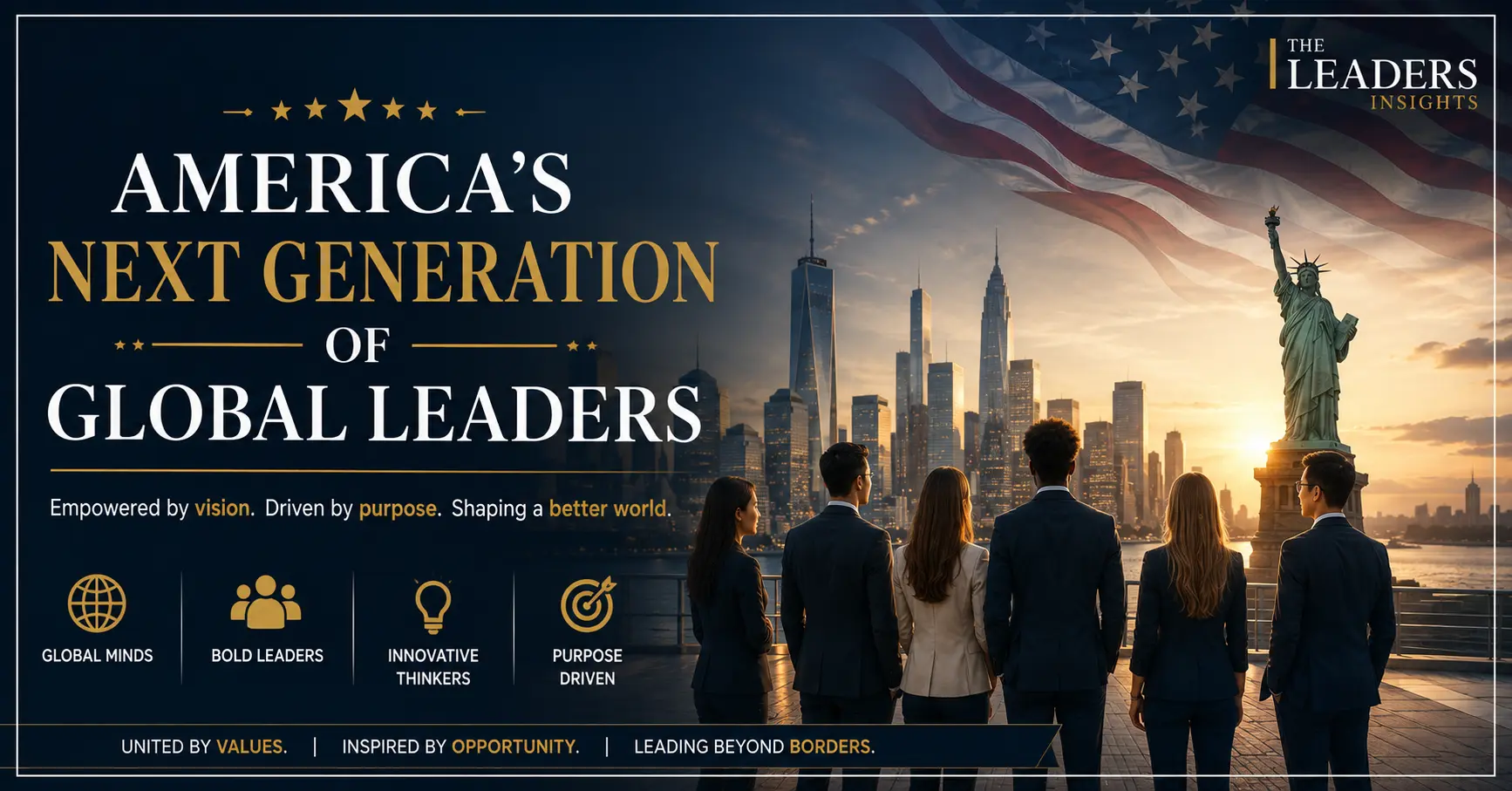
America’s Next Generation of Global Leaders
America has long been shaped by leaders who understood that influence does not stop at national borders. From boardrooms and universities to hospitals, technology companies, public institutions, and civic platforms, American leadership has often carried global weight. Yet the next generation of global leaders will not inherit influence simply because of geography, capital, or institutional history. They will have to earn it in a world that is more connected, more skeptical, and more competitive than ever before.
The United States remains home to many of the world’s most powerful companies, universities, healthcare systems, research institutions, and innovation ecosystems. But leadership today requires more than scale. It requires credibility, adaptability, cultural intelligence, and a long-term view of responsibility.
America’s next generation of global leaders will be defined not only by what they create, but by how they lead through complexity.
Leadership Is Moving Beyond National Advantage
For decades, American leaders benefited from the strength of U.S. markets, institutions, capital networks, and innovation infrastructure. Those advantages still matter. However, they are no longer enough on their own.
The global environment has changed. Emerging economies are producing powerful companies, world-class founders, research talent, and institutional models of their own. Technology has reduced barriers to competition. Talent is more mobile. Capital is more global. Reputation can be built or damaged in real time.
This means the next generation of American leaders must move beyond the assumption that U.S. leadership is automatically global leadership.
A CEO building in Silicon Valley, a university president leading a major academic institution, or a healthcare executive managing a national system must now think with international awareness. Decisions about technology, workforce strategy, research, ethics, sustainability, and institutional trust have global implications.
The leaders who succeed will not see the world only as a market to enter. They will see it as a network of stakeholders, cultures, risks, and partnerships that require understanding before expansion.
The Future Belongs to Leaders with an Institutional Mindset
America’s next generation of global leaders will need to think beyond individual achievement and short-term visibility. The most influential leaders will be institution builders.
An institution-building mindset asks deeper questions: What will this organization stand for ten years from now? How will it create value beyond quarterly performance? What kind of trust will it hold with employees, customers, communities, investors, patients, students, and partners?
This mindset is especially important for CEOs, founders, and CXOs operating in high-growth environments. Speed can create opportunity, but without institutional discipline, it can also create fragility. Many companies grow quickly before they are mature enough to carry the responsibility that comes with influence.
The same is true in higher education and healthcare. Universities are no longer judged only by academic prestige. They are judged by accessibility, research relevance, public trust, and their ability to prepare students for a changing world. Healthcare leaders are no longer evaluated only by operational capacity. They are judged by patient outcomes, workforce resilience, innovation, affordability, and ethical responsibility.
Global leadership requires organizations that can endure scrutiny, adapt to change, and remain credible across different environments. That begins with leaders who understand that legacy is built through systems, culture, and trust.
Cultural Intelligence Will Become a Leadership Advantage
The next generation of American global leaders must lead across differences. That includes geographic, generational, economic, and cultural differences.
Global leadership is not only about speaking on international stages or entering new markets. It means understanding how people with different histories, expectations, and values may interpret the same decisions differently.
A U.S. -based founder expanding into Asia, Europe, or the Middle East cannot rely on the same assumptions that worked in the domestic market. A university leader building international partnerships must understand academic priorities, government expectations, and student mobility trends. A healthcare executive collaborating across borders must be sensitive to policy, access, affordability, and local trust.
Cultural intelligence is not a soft skill. It is a strategic requirement.
Leaders who lack it may still have strong ideas, but they risk misreading markets, damaging partnerships, or appearing disconnected from the people they want to serve. Leaders who develop it can build stronger alliances, make better decisions, and create organizations that feel globally relevant rather than merely internationally present.
Technology Leadership Requires Ethical Clarity
Artificial intelligence, biotechnology, digital health, cybersecurity, automation, and data-driven decision-making are reshaping every major sector. American leaders are often at the center of this transformation, but technological power brings a new level of responsibility.
The next generation of global leaders must understand that innovation without ethical clarity can weaken trust.
This is especially true in the United States, where technology companies, research institutions, healthcare systems, and universities influence global standards. Decisions made in American organizations can shape how people work, learn, receive care, access information, and interact with institutions around the world.
The most respected leaders will not be those who simply adopt new technology the fastest. They will be those who ask better questions before adoption: Does this improve human outcomes? Does it protect privacy? Does it create fairness or deepen inequality? Does it strengthen trust or reduce accountability? Does it serve the mission, or only improve efficiency?
Technology will continue to create powerful advantages. But in the next era of leadership, ethical judgment will become one of the strongest differentiators between leaders who scale influence and leaders who lose public confidence.
Real-World Perspective: Influence Is Being Rewritten
Across the United States, a new leadership profile is emerging. It can be seen in founders who build companies for global customers from the very beginning. It is visible in university leaders redesigning education for a world shaped by AI, changing labor markets, and international student mobility. It is visible in healthcare executives rethinking care delivery, digital infrastructure, and workforce sustainability.
These leaders are operating in a world where trust cannot be assumed. Employees want purpose and transparency. Customers want value and responsibility. Investors want resilience, not only growth. Students want an education that connects with real opportunity. Patients want care that is accessible, human, and reliable.
This shift is forcing leaders to become more multidimensional.
The modern global leader must understand both strategy and culture, as well as innovation and regulation. They must understand growth, but also responsibility. They must communicate with confidence, but also listen with humility.
The old model of leadership often rewarded authority. The new model rewards credibility.
America’s Leadership Future Will Be Earned Through Responsibility
The United States will continue to play a major role in shaping global business, education, healthcare, technology, and institutional development. But the leaders who define the next era will not be those who rely on past American dominance. They will be those who understand the responsibility that comes with influence.
America’s next generation of global leaders will need to build ambitious organizations without being reckless, innovative without being careless, and powerful without being disconnected.
They will need to lead with a wider lens. They will need to recognize that decisions made in one boardroom can affect communities, industries, and markets far beyond their immediate reach. They will need to balance confidence with humility and speed with wisdom.
The future of American leadership will not be measured only by market share, institutional ranking, or global visibility. It will be measured by the ability to build trust across borders, create value across sectors, and lead with purpose.
The next generation of global leaders will not simply represent America to the world. They will help define what responsible leadership looks like in a world that is watching closely.