
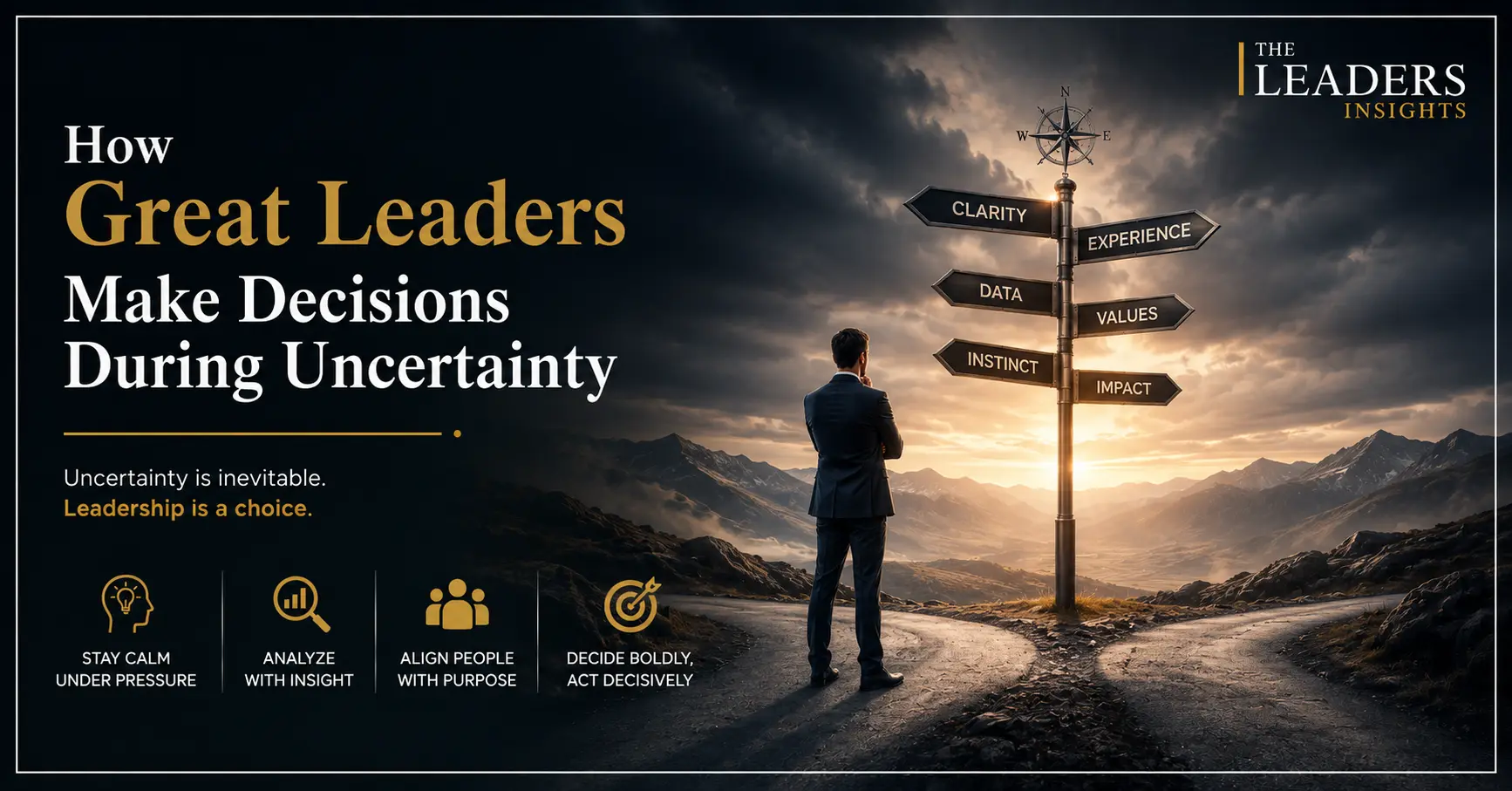
How Great Leaders Make Decisions During Uncertainty
Uncertainty has become one of the defining conditions of modern leadership. In the United States, where businesses, universities, healthcare systems, and public institutions operate within fast-moving economic, political, technological, and social environments, leaders are rarely given the comfort of complete clarity. They must make decisions while markets shift, regulations evolve, public expectations rise, and internal teams look for direction.
For CEOs, founders, university presidents, healthcare executives, and institutional leaders, the question is not whether uncertainty will appear. It always will. The real question is how leaders think, act, and communicate when the path ahead is incomplete.
Great leaders do not wait for perfect conditions. They build the capacity to move forward with discipline, judgment, and purpose.
Leadership Is Tested When Certainty Disappears
In stable times, decision-making often follows a predictable rhythm. Leaders review data, compare options, assess risks, and choose the most reasonable path. But uncertainty changes the environment. Data may be limited. Stakeholders may disagree. Outcomes may be difficult to predict. External pressure may demand speed.
This is where leadership moves beyond management.
A strong executive does not confuse uncertainty with paralysis. They understand that inaction is also a decision, and often a costly one. Delayed decisions can weaken institutional confidence, create operational confusion, and allow competitors or external forces to define the moment.
In American boardrooms, hospital systems, universities, and growth-stage companies, leadership credibility is often shaped during periods of ambiguity. Employees, investors, patients, students, partners, and communities want to see whether leaders can remain calm, thoughtful, and decisive when the future is unclear.
The best leaders bring structure to uncertainty. They do not pretend to know everything. Instead, they clarify what is known, identify what remains unknown, and decide what must be acted upon now.
Great Leaders Separate Noise from Signal
Uncertain environments create information overload. Economic forecasts, media narratives, stakeholder opinions, market rumors, and internal concerns can all compete for attention. A leader’s responsibility is to separate noise from signal.
This requires more than access to data. It requires judgment.
Great leaders ask: What truly matters to the mission? Which risks are temporary, and which could change the organization’s future? Which concerns are emotional reactions, and which are strategic warnings? Which decisions can wait, and which require immediate attention?
For a healthcare executive, this may mean distinguishing between short-term operational strain and a deeper shift in patient expectations. For a university leader, it may mean recognizing whether enrollment pressure is a temporary cycle or a signal of changing perception in higher education. For a founder, it may mean understanding whether a market slowdown is a threat to survival or an opportunity to build with greater discipline.
The ability to filter complexity is one of the most valuable traits of executive leadership. Leaders who react to every signal appear busy, but not necessarily strategic. Leaders who know which signals deserve attention create stability for the entire organization.
Decision-Making Requires Principles, Not Just Predictions
During uncertainty, predictions are fragile. Even the most sophisticated models can fail when conditions shift quickly. That is why great leaders rely not only on forecasts, but on principles.
Principles provide consistency when circumstances change.
A CEO may not know how the market will perform over the next twelve months, but they can know what kind of company they are building. A university president may not know exactly how technology will reshape education, but they can remain committed to academic quality, access, and institutional trust. A healthcare leader may not control policy uncertainty, but they can remain anchored in patient care, workforce resilience, and ethical responsibility.
Principle-based leadership does not mean ignoring financial realities or operational pressures. It means decisions are made through a clear institutional lens. This prevents leaders from making short-term choices that damage long-term credibility.
In the United States, where public trust in institutions is under constant examination, this matters deeply. Stakeholders are not only evaluating what leaders decide. They are evaluating why those decisions were made.
The Strongest Leaders Build Decision-Making Cultures
One of the most important differences between average leaders and great leaders is that great leaders do not make uncertainty a private burden. They build organizations that can think clearly under pressure.
This requires a culture where senior teams can challenge assumptions, share difficult information, and speak honestly about risks. Leaders who surround themselves only with agreement weaken the quality of their decisions. Leaders who invite disciplined disagreement strengthen the organization’s intelligence.
In complex institutions, decisions made during uncertainty often cross multiple departments and stakeholder groups. A healthcare system cannot make workforce decisions without considering patient access, clinical quality, compliance, and financial sustainability. A university cannot make strategic investments without considering students, faculty, donors, accreditation, and long-term reputation. A company cannot pursue growth without understanding capital discipline, customer trust, operational capacity, and brand positioning.
Great leaders create decision-making cultures where different perspectives are heard, but responsibility remains clear. Consensus may be valuable, but it cannot become a substitute for leadership. At some point, the leader must decide.
Communication Is Part of the Decision
A decision is not complete when it is made. It must be communicated with clarity.
During uncertainty, silence creates anxiety. Vague communication creates speculation. Overconfidence can create distrust when reality later proves different. Great leaders communicate with honesty, context, and direction.
They do not need to have an answer. In fact, stakeholders often respect leaders more when they acknowledge uncertainty without losing conviction. The most effective executive communication usually includes three elements: what we know, what we are watching, and what we are doing next.
This approach is especially important in U.S. institutions, where leadership is often visible not only internally but publicly. Employees, boards, investors, students, patients, regulators, and communities may all interpret leadership decisions through different lenses. A strong leader understands that communication is not a soft skill. It is a strategic function.
When leaders explain the reasoning behind a decision, they help people understand the direction, even if the outcome is not guaranteed. That understanding builds trust.
A Real-World Perspective
Across American industries, the past several years have shown that uncertainty does not affect all leaders equally. Some organizations became reactive, defensive, and fragmented. Others used uncertain periods to sharpen priorities, modernize operations, strengthen culture, and reposition for long-term relevance.
The difference was rarely luck alone.
Leaders who performed well did not necessarily have perfect information. They had disciplined thinking. They knew what their institutions stood for. They listened widely without surrendering judgment. They made decisions early enough to matter. They communicated before uncertainty became fear.
In many cases, these leaders also understood that uncertainty can reveal hidden weaknesses. A fragile culture, outdated technology, unclear governance, weak financial discipline, or poor stakeholder trust may remain unnoticed in stable times. Under pressure, these weaknesses become visible. Great leaders use those moments not only to survive, but to transform.
The Future Will Reward Decisive Clarity
The next generation of leadership in the United States will be defined by complexity. Artificial intelligence, demographic shifts, geopolitical tension, workforce expectations, healthcare transformation, education disruption, and economic volatility will continue to reshape executive decision-making.
In this environment, leadership cannot depend on certainty. It must depend on clarity.
Great leaders will be those who can see beyond immediate pressure without ignoring it. They will move with speed, but not recklessness. They will rely on data, but not hide behind it. They will listen to others, but not avoid accountability. They will make decisions that protect today’s operations while preserving tomorrow’s possibilities.
Uncertainty does not weaken great leadership. It reveals it.
The leaders who earn lasting influence are not those who promise a predictable future. They are those who help people move forward when the future is still being formed.