
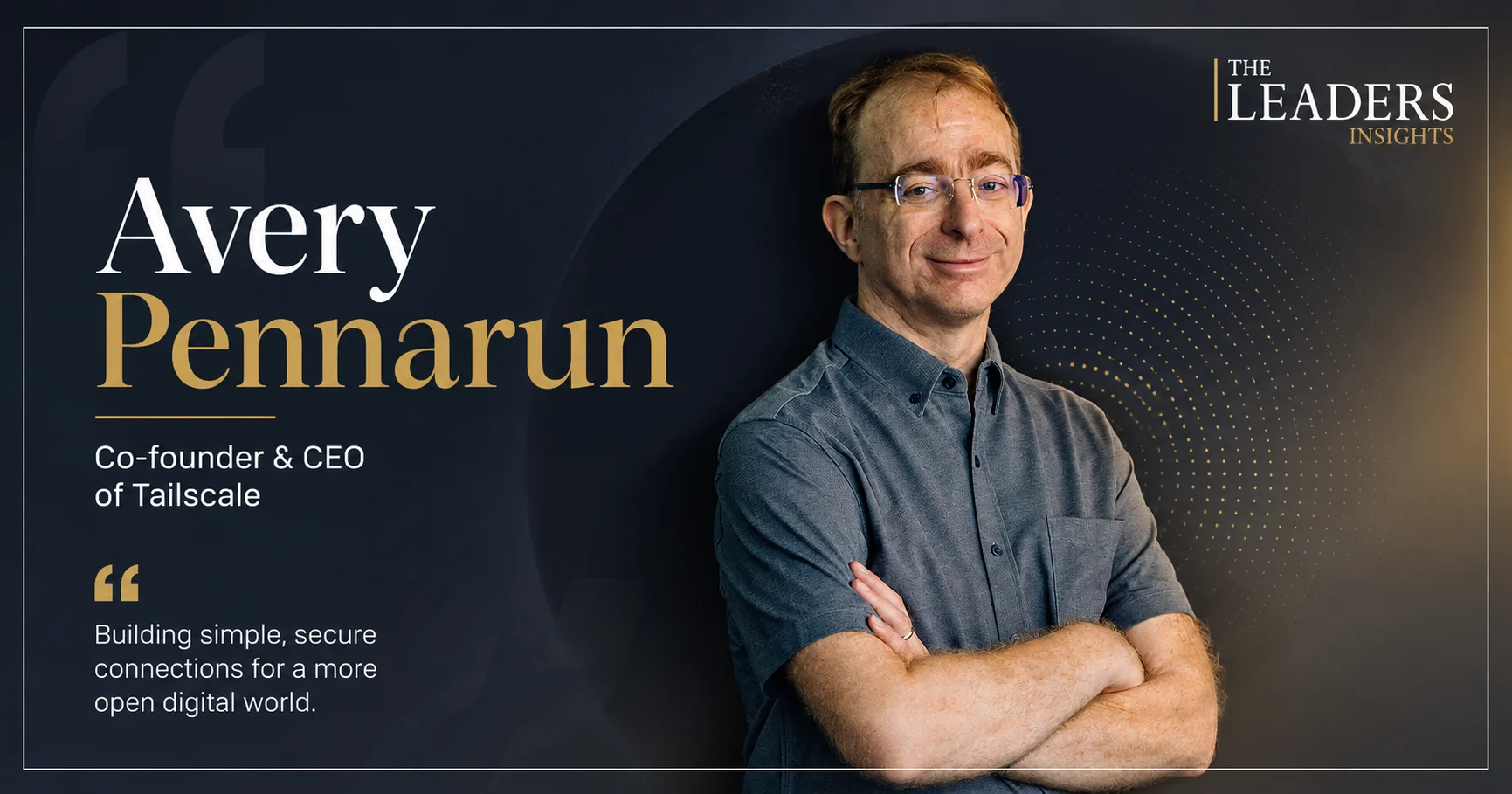
Inside the Vision of Avery Pennarun: How Purpose Shapes Long-Term Leadership
In the technology sector, leadership is often measured by speed, scale, capital, and category creation. Yet the most enduring companies are rarely built on momentum alone. They are built by leaders who understand the deeper reason behind the product, the market, and the institution they are creating.
Avery Pennarun, co-founder and CEO of Tailscale, represents a leadership style that is especially relevant in today’s American innovation economy. At a time when companies are racing to modernize infrastructure, secure distributed teams, support AI workloads, and simplify digital complexity, Pennarun’s leadership story offers a broader lesson: purpose is not a slogan. It is a strategic operating system.
For CEOs, founders, university leaders, healthcare executives, and CXOs, his journey reflects an important truth about long-term leadership. The strongest leaders do not simply chase market opportunities. They identify a problem that matters, stay close to its human impact, and build with enough patience to turn complexity into trust.
Purpose Begins with a Problem Worth Solving
Great leadership often begins before the company exists. It starts with a persistent dissatisfaction: something is too complicated, too inefficient, too inaccessible, or too poorly designed for the people who depend on it.
In Pennarun’s case, the larger problem has long been clear: networking should be easier, safer, and more understandable. For many organizations, secure connectivity has historically been treated as a technical burden. VPNs, access controls, internal networks, cloud environments, and remote infrastructure often become sources of friction between security teams, developers, IT leaders, and end users.
Tailscale’s vision came from a simple belief: networking should not have to be this complicated. That belief is more than a product position. It reflects a leadership philosophy centered on reducing unnecessary complexity.
For U.S. executives operating in complex sectors, this lesson matters. Whether leading a technology company, a healthcare system, a university, or a national institution, the goal is not only to introduce better tools. The goal is to remove barriers that prevent people from doing meaningful work well.
Simplicity Can Be a Strategic Advantage
In enterprise technology, complexity is often mistaken for sophistication. Long implementation cycles, layered systems, specialized language, and complicated workflows can create the impression of depth. But great leadership understands that the most valuable innovations often make hard things feel simple.
Pennarun’s leadership reflects this principle. Tailscale operates in a technically demanding space, yet its broader appeal comes from making secure connectivity more approachable. This is a significant leadership achievement because simplicity at scale requires discipline.
This mindset has deep relevance for American companies and institutions. In healthcare, leaders are trying to simplify patient access while protecting privacy. In higher education, universities are trying to make digital learning and research collaboration more seamless. In corporate environments, distributed teams need secure systems that do not slow down execution.
The future will reward leaders who can make complex systems usable without weakening their integrity. Simplicity is not the absence of sophistication. It is sophistication made accessible.
Long-Term Leadership Requires Technical Conviction and Human Clarity
Avery Pennarun’s leadership is rooted in technical depth, but technical expertise alone does not create a durable company. What separates strong technical founders from long-term leaders is the ability to translate technical conviction into human clarity.
This distinction is important.
Many organizations are now led by executives who must make decisions about cybersecurity, AI, automation, cloud infrastructure, and data governance without reducing those issues to technical language alone. Boards, investors, employees, customers, and regulators need to understand why the technology matters and how it connects to trust, performance, and institutional resilience.
Pennarun’s vision is not only about how networks function. It is about how people connect securely in a digital world that has become increasingly fragmented. That broader framing gives the company’s work a human center.
For leaders across sectors, this is a valuable model. Technical transformation becomes more powerful when it is explained through purpose. People support change more readily when they understand the problem being solved and the future being built.
Purpose Protects Leaders from Short-Term Distraction
One of the greatest challenges for founders and institutional leaders is the pressure to respond to every trend. Markets change. Investors push for acceleration. Competitors introduce noise. Customers demand more. Technology cycles move quickly.
Purpose creates discipline in that environment.
A leader with a clear purpose can say yes to the right opportunities and no to distractions that weaken the mission.
Tailscale’s growth reflects the value of staying close to a defined problem while expanding its relevance. Secure connectivity is no longer a narrow IT concern. It now touches remote work, cloud infrastructure, developer productivity, enterprise security, AI systems, and operational continuity. A clear mission can expand naturally when the problem it addresses becomes more important to the world.
This is a powerful lesson for CEOs and CXOs. Long-term leadership is not built by chasing every adjacent opportunity. It is built by understanding which opportunities deepen the organization’s purpose and which ones dilute it.
Real-World Perspective: Building Trust in Invisible Infrastructure
Some of the most important companies in the modern economy are not always the most visible to the general public. They build infrastructure, security layers, data systems, workflow platforms, and networks that allow other organizations to function.
Leadership in this kind of company requires a different kind of vision. The product may operate behind the scenes, but the impact is deeply felt. When infrastructure works, people may barely notice it. When it fails, the consequences can be immediate and costly.
This is why trust is central to Pennarun’s leadership story. Tailscale operates in a space where reliability, security, and ease of use are not optional. Customers are not only buying software. They are placing confidence in a system that supports how their teams connect and operate.
For American executives, this is increasingly familiar. Healthcare leaders rely on invisible digital systems to protect patient care. Universities depend on secure networks to support research and learning. Enterprises depend on infrastructure that keeps teams productive across locations, platforms, and devices.
The leaders who build these systems carry a responsibility that extends beyond growth metrics. They are helping define the foundation on which modern institutions operate.
The Leadership Lesson: Purpose Must Become Operational
The most meaningful leadership visions are not kept in speeches, interviews, or brand statements. They become visible in product decisions, hiring standards, customer relationships, investor choices, and organizational culture.
Avery Pennarun’s leadership shows that purpose becomes real when it is operational. The goal of making networking simpler and more secure is not abstract. It influences how the company builds, communicates, scales, and earns trust.
That is the larger lesson for leaders across industries. Purpose is not valuable because it sounds inspiring. It is valuable because it creates alignment. It helps organizations make better decisions under pressure. It gives teams a clearer sense of what matters. It gives customers and stakeholders a reason to believe the organization is building for more than short-term gain.
A Forward-Looking View of Purpose-Driven Leadership
The next era of leadership will be shaped by complexity. Artificial intelligence, cybersecurity, distributed work, digital trust, global competition, and institutional transformation will continue to redefine how organizations operate.
In this environment, leaders like Avery Pennarun offer a timely model. The future will not belong only to those who move quickly. It will belong to those who know why they are moving, what problem they are solving, and how their work creates lasting value.
Purpose-driven leadership is not soft. It is strategic. It gives leaders the clarity to build through uncertainty, the discipline to simplify complexity, and the credibility to earn trust over time.
Long-term leadership is ultimately shaped by the ability to turn conviction into systems that serve people well. That is where vision becomes institution. That is where purpose becomes legacy.