Top 25 SaaS CEOs in the USA
Software as a Service has moved far beyond being a convenient way to buy business software. SaaS platforms now sit at the center of how companies sell, communicate, manage employees, secure data, build products, analyze information, and increasingly deploy artificial intelligence.
That change has also transformed the job of a SaaS CEO.
Today’s most influential SaaS leaders are not simply managing subscription businesses. They are deciding how quickly their companies should adopt AI, which products should become platforms, where automation can create real value, and how to keep customers loyal in an increasingly crowded software market.
The United States remains home to many of the companies shaping this evolution. From established enterprise software giants such as Salesforce, Adobe, and ServiceNow to newer category leaders such as Figma and Rippling, American SaaS companies continue to influence how organizations around the world operate.
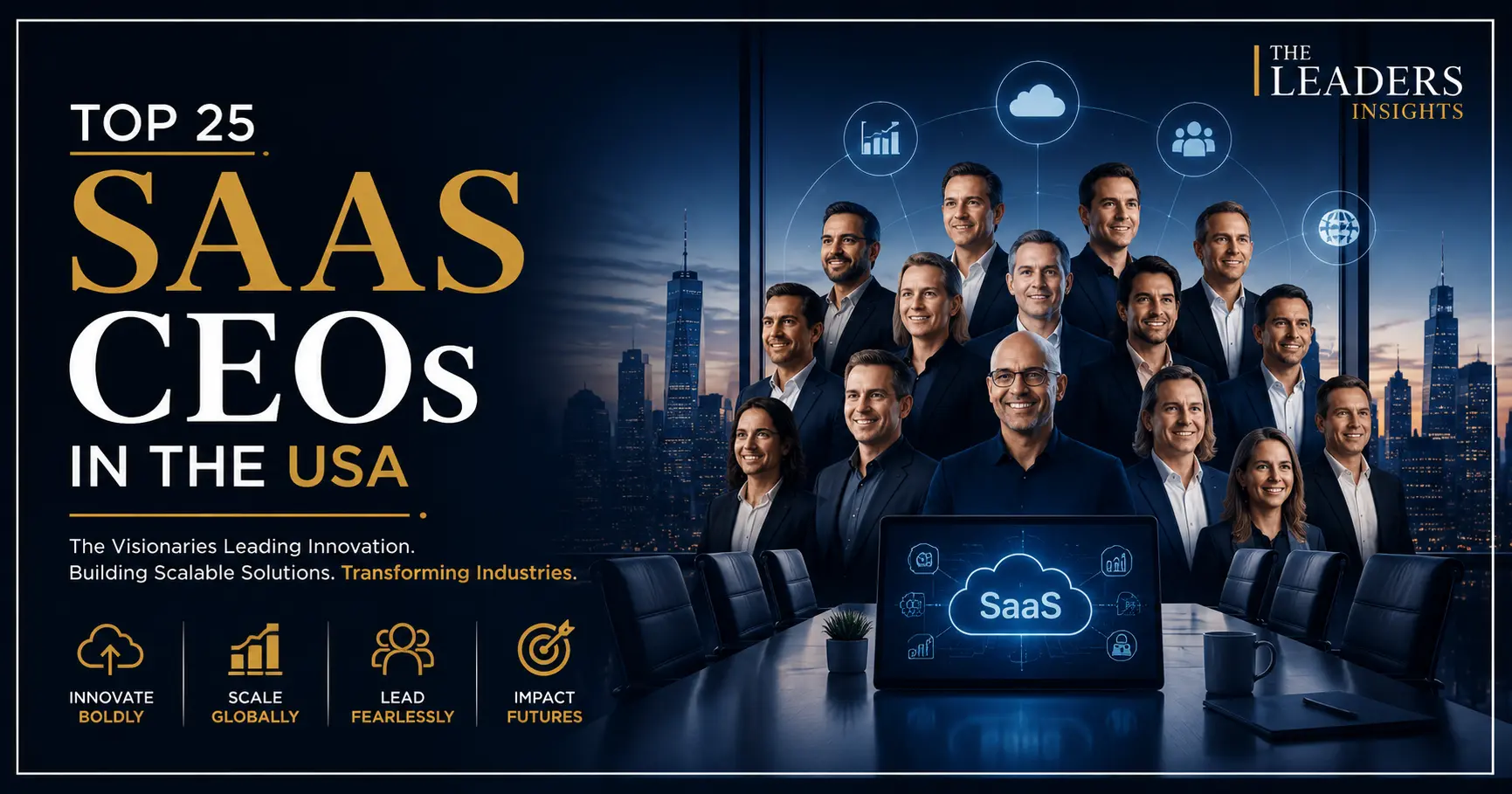
Here are 25 of the top SaaS CEOs in the USA to know in 2026, selected for their influence, company scale, innovation, market impact, and role in shaping the next generation of cloud software.
1. Marc Benioff — Salesforce
Few executives have influenced the SaaS business model as deeply as Marc Benioff, Chair, CEO, and Co-Founder of Salesforce.
Salesforce helped establish cloud-delivered enterprise software as a mainstream alternative to traditional on-premise systems. More than two decades later, Benioff is again trying to position the company around a major technology transition: AI agents.
Salesforce increasingly describes its future around the “Agentic Enterprise,” with AI agents working alongside employees across sales, service, marketing, data, and other business functions. The company reported fiscal 2026 revenue of $41.5 billion, showing just how large the cloud-software model Benioff helped popularize has become.
For SaaS founders, Benioff remains an important example of how a company can evolve from a single application into a broad enterprise platform.
2. Shantanu Narayen — Adobe
Shantanu Narayen has led one of the most significant business-model transformations in modern software.
Adobe was once largely known for packaged software. Under Narayen, products including Photoshop, Illustrator, and Acrobat moved toward cloud subscriptions through services such as Creative Cloud and Document Cloud.
Today, Adobe is undergoing another transition as generative AI changes how creative work is produced.
Narayen announced in March 2026 that he plans to step down as CEO once a successor is appointed. Until that transition occurs, he remains Chair and Chief Executive Officer. His long tenure offers SaaS leaders a valuable lesson in recognizing when a successful product model needs to be reinvented before the market forces the change.
3. Bill McDermott — ServiceNow
Enterprise SaaS leadership often requires making complicated technology easy for executives to understand. Bill McDermott, Chairman and CEO of ServiceNow, has built much of his leadership reputation around that ability.
Since joining ServiceNow in 2019, McDermott has overseen a significant expansion of the company’s workflow platform.
ServiceNow now wants to play an even larger role in enterprise AI, connecting people, processes, data, devices, and intelligent agents through a common platform. The company says its full-year revenue has more than tripled since McDermott joined.
His experience demonstrates the value of combining enterprise sales discipline with a clear platform strategy.
4. Sasan Goodarzi — Intuit
Under Sasan Goodarzi, Intuit has expanded far beyond its roots in tax and accounting software.
The company behind TurboTax, QuickBooks, Credit Karma, and Mailchimp increasingly presents itself as an AI-driven financial technology platform.
Goodarzi became CEO in 2019 and has pushed Intuit toward using proprietary data, AI, and human expertise together to help consumers and businesses make financial decisions. Intuit says revenue increased from $7.7 billion to $18.8 billion between his appointment and fiscal 2025.
His strategy reflects an important SaaS trend: mature software businesses increasingly compete on the intelligence built into their platforms, not simply the number of features they offer.
5. Aneel Bhusri — Workday
Workday entered a new chapter in February 2026 when co-founder Aneel Bhusri returned to the CEO position.
Bhusri originally helped build Workday around cloud-based human resources and financial management. The company’s current challenge is broader: helping enterprises manage people, money, and a growing number of AI agents.
Workday described Bhusri’s return as part of its effort to lead through the rapidly changing AI era. He had previously served as CEO and co-CEO in different periods before moving to executive chair in 2024.
His return highlights how important product vision has become as established SaaS companies rethink themselves (around AI).
6. Sridhar Ramaswamy — Snowflake
Data has become one of the foundations of enterprise AI, placing Sridhar Ramaswamy in an increasingly important position.
Ramaswamy became CEO of Snowflake in 2024 after previously serving as the company’s Senior Vice President of AI. He brought deep experience in search, machine learning, and data technology to the role.
Under his leadership, Snowflake is positioning its cloud data platform as infrastructure not only for analytics but for AI applications and enterprise intelligence.
His appointment also illustrates a wider shift in SaaS leadership: technical and AI experience is becoming increasingly valuable at the CEO level.
7. Yamini Rangan — HubSpot
Yamini Rangan represents a customer-focused approach to SaaS leadership.
Before becoming HubSpot CEO, she served as the company’s first Chief Customer Officer. Her previous experience also included senior roles at Dropbox, Workday, and SAP.
HubSpot has since evolved from its inbound-marketing roots into a broader customer platform spanning marketing, sales, service, commerce, content, and CRM. In 2026, the company has been emphasizing its transition toward an agentic customer platform and AI-powered tools for growing businesses.
Rangan’s leadership reinforces a simple principle that can sometimes disappear in the race toward AI: successful SaaS companies still need to solve real customer problems.
8. Eric Yuan — Zoom
Few SaaS leaders experienced growth as sudden and globally visible as Eric Yuan, Founder and CEO of Zoom.
Zoom became essential infrastructure for remote communication during the pandemic. The harder leadership challenge came afterward: turning that enormous adoption wave into a broader, durable enterprise business.
Zoom has responded by expanding beyond video meetings into workplace collaboration, contact-center technology, productivity tools, and AI-powered communication.
Yuan has served as CEO since founding the company and continues to oversee its transition from a video-conferencing product into a broader communications platform.
His journey is particularly relevant to SaaS founders managing the difficult shift from breakout product to diversified platform.
9. Todd McKinnon — Okta
Identity has become central to cybersecurity, particularly as businesses add more cloud applications, remote users, connected systems, and AI agents.
That puts Todd McKinnon, CEO and Co-Founder of Okta, at the center of an important SaaS category.
Okta provides identity technology used to manage and secure access to applications and systems. In its fiscal 2026 results, McKinnon specifically pointed to the need to secure identities not only for humans but also for AI agents.
His leadership reflects how cybersecurity SaaS is changing: identity is no longer just an IT login problem. It is becoming part of the infrastructure required to operate modern digital businesses safely.
10. Chirantan “CJ” Desai — MongoDB
MongoDB entered a new leadership era when Chirantan “CJ” Desai became President and CEO in November 2025, succeeding longtime CEO Dev Ittycheria.
Desai brought more than 25 years of experience across cloud infrastructure, software, product development, and cybersecurity. Before MongoDB, he held leadership roles at Cloudflare and ServiceNow.
His task is strategically important. As companies build more AI applications, databases need to handle increasingly complex combinations of structured, unstructured, real-time, and application data.
MongoDB is positioning itself as a modern data platform for that environment.
11. George Kurtz — CrowdStrike
Cybersecurity SaaS is one of the most competitive areas of enterprise technology, and George Kurtz remains one of its most visible founder-CEOs.
Kurtz founded CrowdStrike and has built the company around cloud-delivered security, threat intelligence, and endpoint protection.
His background includes more than three decades in cybersecurity, including leadership positions at McAfee and the founding of Foundstone.
As cyber threats become faster and AI increases both defensive and offensive capabilities, Kurtz’s challenge is no longer simply detecting threats. It is helping enterprises consolidate security operations while responding to attacks at machine speed.
12. Jay Chaudhry — Zscaler
Jay Chaudhry, Founder, Chairman, and CEO of Zscaler, has spent much of his career building cybersecurity companies.
Zscaler helped advance the idea that enterprise security could move away from traditional network perimeters and toward cloud-based, zero-trust architectures.
That model has become increasingly relevant as employees, applications, devices, and data operate across many locations rather than inside one corporate network.
Chaudhry has led Zscaler since its founding and previously founded several other security businesses.
His career is a reminder that some of the strongest SaaS companies emerge when founders identify infrastructure shifts before they become obvious to the wider market.
13. Olivier Pomel — Datadog
As technology stacks become more complicated, businesses need better visibility into what their applications and infrastructure are doing.
That need helped create Datadog, led by Co-Founder and CEO Olivier Pomel.
Datadog brings observability, application monitoring, infrastructure monitoring, security, data, and other capabilities into a common cloud platform. The company is increasingly positioning itself around observability and security for the AI era.
Pomel’s leadership stands out because Datadog has expanded carefully from an engineering-focused monitoring product into an enterprise platform without abandoning its technical user base.
14. Allan Thygesen — DocuSign
Electronic signatures transformed one part of business. Allan Thygesen is now trying to transform what happens before and after the signature.
Since becoming CEO of DocuSign in 2022, Thygesen has pushed the company beyond e-signatures toward what it calls Intelligent Agreement Management.
That includes using AI and automation to help businesses create, manage, analyze, and act on contracts. DocuSign reported more than 1.6 million customers, while its newer Intelligent Agreement Management offering continues to expand.
For mature SaaS businesses, this is a familiar challenge: owning a popular category is valuable, but expanding the problem the company solves can create the next stage of growth.
15. Khozema Shipchandler — Twilio
Khozema Shipchandler took over as Twilio CEO in 2024 after serving in several senior positions within the company.
His leadership has focused on combining innovation with stronger operating and financial discipline.
Twilio provides communications and customer-engagement infrastructure that lets businesses embed messaging, voice, authentication, data, and related capabilities into digital experiences.
The company is now positioning itself as infrastructure for customer engagement in the AI era. Twilio reported $1.41 billion in first-quarter 2026 revenue, up 20% year over year.
Shipchandler’s tenure shows how SaaS CEOs increasingly need to balance growth, profitability, platform investment, and AI transformation simultaneously.
16. Aaron Levie — Box
Aaron Levie has been CEO of Box since co-founding the company in 2005.
Box began with a relatively straightforward proposition: make it easier for businesses to store and share files in the cloud.
The company has since evolved toward enterprise content management, collaboration, security, workflow, and AI. Box now describes its broader direction as Intelligent Content Management.
Levie has remained closely associated with the company’s product direction throughout that evolution.
His long tenure makes him a useful example of founder-led SaaS leadership—and of how a company can continue expanding its category while staying connected to the problem it originally set out to solve.
17. Dylan Field — Figma
Dylan Field, Co-Founder and CEO of Figma, leads one of the most closely watched companies in modern design software.
Figma helped move product design from locally installed tools toward a collaborative, browser-based environment where designers, developers, product managers, and other teams could work together.
That vision has expanded significantly.
Figma is increasingly connecting design, prototyping, development, and AI-assisted creation. The company reported first-quarter 2026 revenue growth of 46% year over year, reflecting continued expansion following its public-market debut.
Field represents a younger generation of SaaS founders building products around multiplayer collaboration rather than simply moving older workflows into the cloud.
18. Parker Conrad — Rippling
HR software is crowded, but Parker Conrad has approached the market with a broader idea.
Rippling combines HR, IT, finance, payroll, identity, devices, benefits, and other workforce operations around a shared employee-data model.
Conrad, Rippling’s Co-Founder and CEO, has argued for unusually heavy investment in research and product development compared with many SaaS businesses.
That product-led approach has helped Rippling become one of the most closely watched private enterprise-software companies in the United States.
For SaaS founders, Conrad’s strategy offers an interesting lesson: sometimes the larger opportunity appears when several adjacent software categories can be rebuilt around the same underlying data.
19. Bill Staples — GitLab
Bill Staples became CEO of GitLab in December 2024, succeeding Co-Founder Sid Sijbrandij.
GitLab has evolved from a developer collaboration platform into a broader DevSecOps environment covering much of the software-development lifecycle.
Now, AI is changing that lifecycle again.
GitLab increasingly describes itself as an intelligent orchestration platform for DevSecOps, aiming to help organizations coordinate human developers, AI capabilities, security, governance, and software delivery.
Staples’ leadership will be worth watching because developer software sits directly in the path of one of AI’s fastest-moving transformations: how software itself gets built.
20. Peter Gassner — Veeva Systems
Not every successful SaaS company needs to serve every industry.
Peter Gassner, Founder and CEO of Veeva Systems, has demonstrated the potential of deep vertical specialization.
Veeva builds cloud software specifically for life sciences, serving pharmaceutical, biotechnology, and related organizations across areas such as commercial operations, clinical processes, quality, data, and content.
Gassner remains responsible for Veeva’s overall strategic and product direction.
Veeva is an important case study for SaaS entrepreneurs because it shows how industry expertise and specialized workflows can create a powerful competitive advantage against more general enterprise platforms.
21. Ajei Gopal — Procore
Construction is one of the world’s largest industries, yet many of its workflows have historically been fragmented and manual.
Procore is trying to change that, now under CEO Ajei Gopal.
Gopal officially became President and CEO in November 2025, succeeding Founder Tooey Courtemanche. He previously led engineering-simulation company Ansys and brings decades of enterprise technology experience to Procore.
Procore is increasingly investing in AI alongside its construction-management platform. Its first-quarter 2026 revenue reached $359 million, up 16% year over year.
Gopal’s leadership highlights the growing importance of vertical SaaS in industries that still have significant room for digitization.
22. Dan Rogers — Asana
Dan Rogers became CEO of Asana in July 2025, succeeding Co-Founder Dustin Moskovitz.
His arrival came at an important moment for the work-management company.
Asana built its reputation by helping teams organize projects, tasks, goals, and workflows. The next opportunity is coordination between employees and AI systems.
The company now describes itself as a platform where humans and AI can work together, with AI Studio and related capabilities becoming part of its broader enterprise strategy.
Rogers will be closely watched as Asana tries to redefine traditional project management for the agentic workplace.
23. Dennis Woodside — Freshworks
Freshworks has one of the more unusual stories in enterprise SaaS.
Founded in India and now headquartered in California, the company grew into a publicly traded provider of customer-service and employee-service software.
Dennis Woodside became CEO and President in 2024, succeeding Founder Girish Mathrubootham, who moved to Executive Chairman.
Woodside is now leading Freshworks through an AI-driven transition while the company expands further into larger enterprise accounts.
In May 2026, he said more than half of Freshworks’ large deals included AI, illustrating how quickly intelligent features are moving from optional add-ons to core SaaS buying decisions.
24. Bill Magnuson — Braze
Customer engagement has grown far more complex as consumers move between apps, websites, email, messaging, and other digital channels.
Braze was built for that environment.
Co-Founder and CEO Bill Magnuson has led the company as it developed into a major customer-engagement platform used by brands to coordinate personalized interactions across channels.
In fiscal Q1 2027, reported in May 2026, Braze posted 30% year-over-year revenue growth and continued expanding its AI capabilities for marketers.
Magnuson’s leadership is particularly relevant for marketing SaaS because AI is moving the category from workflow automation toward increasingly autonomous decision-making and personalization.
25. Aman Narang — Toast
Aman Narang, Co-Founder and CEO of Toast, represents another major trend in SaaS: vertical platforms built around the complete operating needs of one industry.
Toast combines cloud software with payments and other technology designed specifically for restaurants and hospitality businesses.
Rather than solving a single problem, Toast serves as an all-in-one operating platform—powering everything from POS and digital ordering to marketing, payroll, and fintech.
By the first quarter of 2026, Toast’s annualized recurring run-rate had reached $2.2 billion. The company is also introducing AI tools designed to help restaurant operators make better decisions and generate demand.
Narang’s leadership demonstrates why vertical SaaS continues to be one of the most compelling areas of the U.S. software market.
What the Top SaaS CEOs Have in Common
These 25 SaaS CEOs lead very different businesses, but several patterns connect them.
The first is AI integration. Almost every major SaaS company is moving from adding individual AI features to reconsidering how its entire platform should operate when intelligent agents can complete work on behalf of users.
The second is platform expansion. Salesforce is moving beyond CRM, DocuSign beyond signatures, Figma beyond design, Toast beyond point of sale, and HubSpot beyond marketing. Successful SaaS companies increasingly want to own a connected workflow rather than a single task.
A third trend is specialization. Veeva, Procore, and Toast show that some of the strongest opportunities exist not in serving every business but in understanding one industry’s problems better than anyone else.
Finally, today’s best SaaS leaders are paying greater attention to efficient growth. The era when software companies could prioritize customer acquisition almost regardless of cost has changed. CEOs increasingly have to prove that innovation, recurring revenue, customer retention, margins, and cash generation can improve together.
Why SaaS Leadership Matters More in the AI Era
For years, the SaaS formula seemed relatively clear: move a business process to the cloud, make the product easy to adopt, charge customers a recurring subscription, and steadily add features.
AI is making that formula less predictable.
Some tasks that once required users to navigate software manually can now be completed through natural-language interfaces or autonomous agents. That raises a difficult question for every SaaS CEO: What is the value of software when users no longer need to interact with it?
The leaders who answer that question successfully could define the next generation of enterprise technology.
They will need to decide which parts of their products should become automated, how proprietary data can create an advantage, how AI should be priced, and where human oversight remains essential.
That makes SaaS leadership in 2026 as much about reinventing existing business models as building new products.
Final Thoughts
The top SaaS CEOs in the USA are leading their companies through one of the industry’s most important transitions since cloud computing first challenged traditional software.
Marc Benioff is pushing Salesforce toward AI agents. Shantanu Narayen is guiding Adobe through generative AI while preparing for a leadership transition. Aneel Bhusri has returned to Workday as the company rethinks enterprise software around AI. Meanwhile, leaders such as Dylan Field, Parker Conrad, Aman Narang, and Bill Magnuson are showing how newer SaaS businesses can create entirely different categories and workflows.
There will not be a single model for winning.
Some companies will succeed through scale. Others will win through deep industry expertise, stronger data, better customer experiences, developer ecosystems, security, or highly specialized AI.
What the strongest SaaS leaders share is a willingness to keep redefining what their companies can become.
And as AI changes how people interact with software itself, that ability to adapt may become the most valuable leadership skill of all.