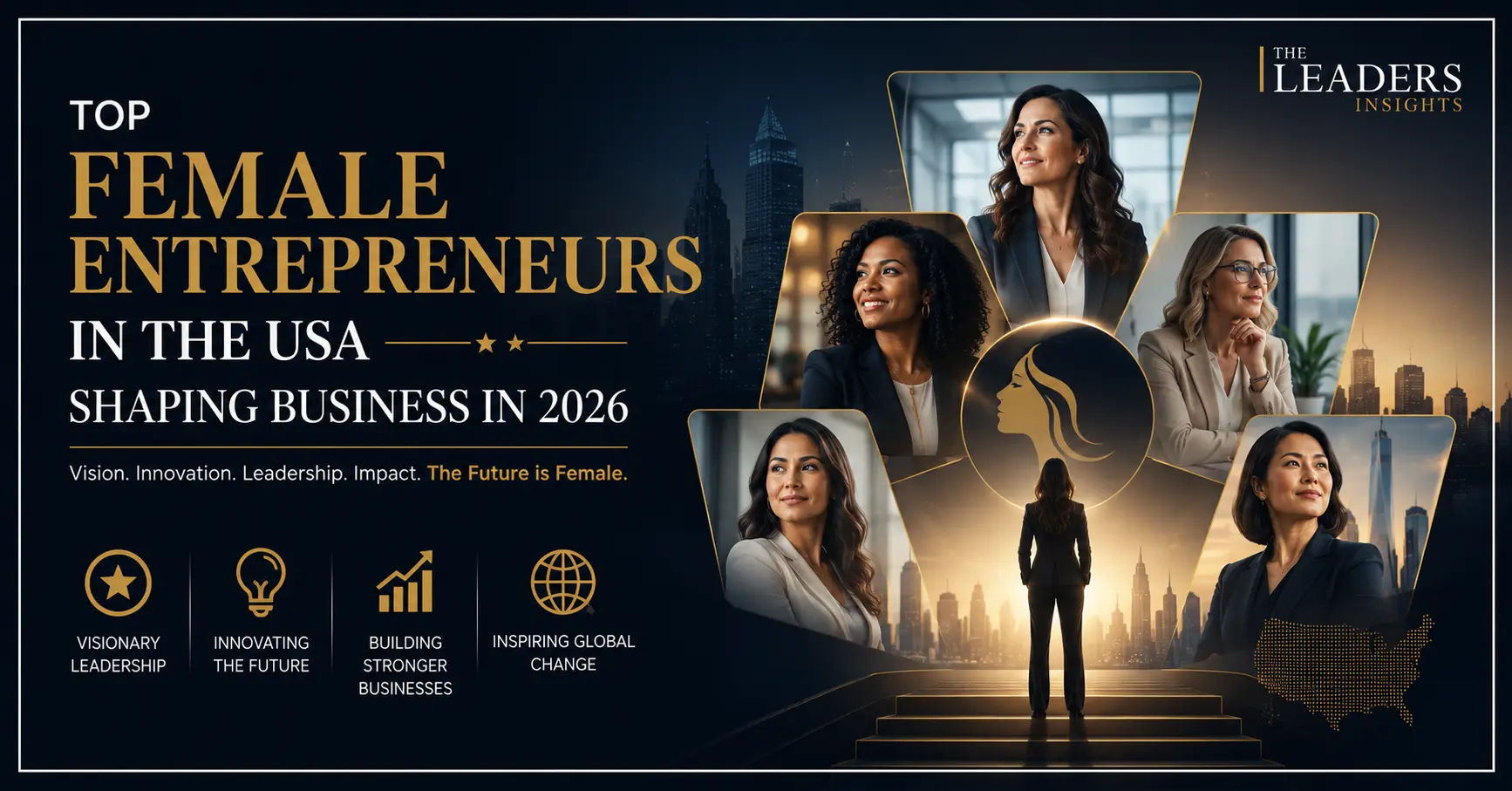
Top Female Entrepreneurs in the USA
Entrepreneurship in the United States is changing quickly, and women are playing an increasingly visible role in that transformation.
Across artificial intelligence, healthcare, fashion, cybersecurity, consumer products, and digital services, female founders are building companies that challenge established industries. Some have created billion-dollar businesses. Others are developing technologies that could influence how Americans work, communicate, shop, and receive healthcare for years to come.
But success in entrepreneurship is not only about valuation.
The most influential female entrepreneurs in the USA tend to have something else in common: they identify a problem that millions of people experience and build a company around solving it differently.
Some of the women on this list are experienced entrepreneurs who have spent decades building brands. Others are leading relatively young companies in fast-moving markets such as artificial intelligence.
This is not a ranking based purely on personal wealth or company valuation. Instead, the selection considers business impact, innovation, leadership, industry influence, and current relevance.
Here are 10 of the top female entrepreneurs in the USA to know in 2026.
1. Sara Blakely — Founder of Spanx and Sneex
Industry: Fashion and Consumer Products
Sara Blakely remains one of the most recognizable examples of American entrepreneurship.
Her story began with a simple consumer problem. She wanted a smoother look under a pair of white pants, cut the feet off a pair of control-top pantyhose, and eventually turned that idea into Spanx.
Blakely started the company with $5,000 in personal savings and without traditional outside investment. Spanx grew from one innovative shapewear product into an international apparel brand. In 2021, Blackstone acquired a majority stake in the business in a deal that valued Spanx at $1.2 billion.
What makes Blakely especially relevant today is that she did not stop after Spanx.
In 2024, she launched Sneex, a footwear company combining features of a sneaker with a high heel. The brand remains active in 2026 and describes Blakely as its founder and inventor.
Blakely’s second act proves a vital point: a successful founder isn’t trapped by the product that made them famous.
Why she stands out: Blakely has built her career around identifying everyday consumer frustrations and turning them into products people are willing to pay for.
2. Mira Murati — Co-Founder and CEO of Thinking Machines Lab
Industry: Artificial Intelligence
Few new technology companies have attracted as much attention as Thinking Machines Lab.
Its co-founder and CEO, Mira Murati, previously served as chief technology officer at OpenAI, where she played an important role during the development and expansion of products including ChatGPT and DALL-E.
Murati launched Thinking Machines Lab in 2025 with a team that included prominent AI researchers and engineers. The company is working on advanced AI systems designed to be more customizable and collaborative.
Investor interest arrived almost immediately.
Thinking Machines raised approximately $2 billion in an early funding round that valued the young company at about $12 billion. In March 2026, it announced a major strategic partnership with Nvidia that includes access to at least one gigawatt of next-generation computing systems as well as an investment from Nvidia.
That is an extraordinary level of backing for such a young business.
Why she stands out: Murati is not simply launching another AI application. She is attempting to build a frontier AI company in direct competition with some of the world’s best-funded technology organizations.
3. Daniela Amodei — Co-Founder and President of Anthropic
Industry: Artificial Intelligence
Daniela Amodei is another woman helping shape the direction of the global AI industry.
She co-founded Anthropic with Dario Amodei and other former OpenAI employees in 2021. Today, she serves as the company’s president and co-founder. Anthropic develops Claude, a family of artificial intelligence models used by consumers, developers, and businesses.
Her role is especially significant because building an AI company requires far more than developing powerful models.
It requires recruiting highly specialized employees, building partnerships, creating enterprise relationships, navigating government policy, and determining how increasingly capable technology should be deployed.
Anthropic continues expanding internationally and across enterprise markets. In 2026, the company has also continued developing its governance structure around the responsible development of advanced artificial intelligence.
Amodei therefore represents a different type of entrepreneur: one operating at the intersection of technology, organizational leadership, public policy, and responsible innovation.
Why she stands out: As AI becomes more powerful, the executives determining how these systems are developed and commercialized may influence far more than the technology industry itself.
4. Whitney Wolfe Herd — Founder and CEO of Bumble
Industry: Consumer Technology
Whitney Wolfe Herd changed online dating by building a product around a clear difference: giving women greater control over how conversations begin.
She founded Bumble in 2014 and helped turn the company into one of the most recognized dating platforms in the United States.
Bumble went public in 2021. Wolfe Herd later stepped away from the CEO position, serving as executive chair from January 2024 until March 2025. She then returned as CEO.
Her return is particularly interesting because Bumble is navigating a difficult period for the broader dating-app industry.
In the first quarter of 2026, Bumble reported lower revenue compared with the previous year while also reporting higher net earnings. Wolfe Herd said the company was preparing a redesigned, AI-enabled Bumble experience as part of its effort to improve product quality and user experience.
That makes this stage of her entrepreneurial career very different from Bumble’s early growth years.
Now, the challenge is reinvention.
Why she stands out: Great entrepreneurship is not only about starting companies. It can also require returning to a business and redefining it when customer behavior and markets change.
5. Emma Grede — Co-Founder and CEO of Good American
Industry: Fashion, Consumer Brands and Retail
Emma Grede has built a career around understanding modern consumers and translating those insights into scalable brands.
She is co-founder and CEO of Good American, founding partner of SKIMS, and co-founder of additional businesses including Safely and Off Season. Although British-born, Grede is based in Los Angeles and has become a major figure in the U.S. consumer business landscape.
Good American, which Grede co-founded with Khloé Kardashian, was built around a more inclusive approach to fashion and sizing.
Her wider career also demonstrates the power of partnerships in modern entrepreneurship. Instead of treating celebrity, product development, branding, distribution, and social media as separate functions, Grede has helped combine them into highly visible consumer businesses.
Her influence now extends beyond operating companies. She has become an investor, mentor, media personality, and prominent voice on entrepreneurship and leadership.
Why she stands out: Grede understands that today’s strongest consumer brands need more than good products. They need community, cultural relevance, strong positioning, and disciplined execution.
6. Christina Cacioppo — Founder and CEO of Vanta
Industry: Cybersecurity and Compliance Technology
Security compliance rarely gets the same hype as consumer apps or artificial intelligence.
Christina Cacioppo saw a major business opportunity in it anyway.
She founded Vanta in 2018 after encountering the complicated process of achieving SOC 2 compliance while working on Dropbox Paper. Vanta now helps organizations automate security, compliance, risk, and trust management.
The business has expanded rapidly.
In April 2026, Cacioppo announced that Vanta had passed $300 million in annual recurring revenue. The company had reached $200 million only nine months earlier. Vanta also said that 60% of the companies appearing on the Forbes AI 50 were customers.
Its growth reflects a wider shift in American business.
As companies collect more data and adopt more cloud and AI technology, customers increasingly expect them to demonstrate that their systems are secure.
Compliance is moving from a back-office requirement toward a business necessity.
Why she stands out: Cacioppo turned a complicated and often frustrating business process into a high-growth technology category.
7. Dr. Toyin Ajayi — Co-Founder and CEO of Cityblock Health
Industry: Healthcare
Dr. Toyin Ajayi represents a growing group of entrepreneurs trying to improve American healthcare through new business models rather than technology alone.
She is the co-founder and CEO of Cityblock Health, a healthcare company focused heavily on people covered by Medicaid and other populations with complex medical and social needs.
Cityblock combines medical care with behavioral health and support for needs that can directly affect health, including housing, food, transportation, and access to social services.
Ajayi’s experience as a physician helped shape the company’s approach.
Rather than starting with the question, “What technology can we sell?” Cityblock started with a more fundamental problem: why does the existing healthcare system fail so many patients?
The company now operates across multiple U.S. states and Washington, D.C. It is also exploring how AI can improve care for Medicaid populations rather than allowing emerging healthcare technologies to benefit only wealthier patients.
Why she stands out: Ajayi demonstrates how entrepreneurship can address both a major commercial market and a major social problem.
8. Dr. Iman Abuzeid — Co-Founder and CEO of Incredible Health
Industry: Healthcare Technology and Workforce
The United States continues to face significant healthcare workforce challenges.
Dr. Iman Abuzeid built Incredible Health around one part of that problem: helping healthcare organizations hire permanent healthcare professionals more efficiently.
Abuzeid is the company’s co-founder and CEO. Trusted by 1.5 million U.S. nurses, Incredible Health uses AI to help healthcare employers hire faster. The company has raised $100 million and is valued at $1.65 billion, according to its own corporate information.
The company has also introduced AI voice agents designed to assist healthcare workers and employers through the recruiting process.
That’s remarkable because most conversations about AI in healthcare stick strictly to clinical diagnosis or medical documentation. Workforce management is another enormous opportunity.
A hospital cannot provide care without enough nurses, technicians, and other healthcare professionals.
Why she stands out: Abuzeid combines medical knowledge with entrepreneurship and is applying AI to one of healthcare’s most persistent operational problems.
9. Sarah Paiji Yoo — Co-Founder and CEO of Blueland
Industry: Sustainability and Consumer Products
Sarah Paiji Yoo built Blueland around something most households use constantly: cleaning products.
Her concern began with plastic waste.
After learning more about microplastics while preparing for motherhood, Yoo became frustrated by how difficult it was to find effective household products without large amounts of disposable plastic packaging.
That experience became the foundation for Blueland.
The company develops reusable containers and concentrated refill products intended to reduce reliance on single-use plastic. Blueland says its products have helped divert more than one billion plastic cleaning bottles from landfills and oceans.
Her company is interesting because sustainability businesses face a difficult challenge.
Consumers may say they want environmentally responsible products, but those products still have to be affordable, convenient, well-designed, and effective.
Environmental benefits alone are rarely enough to create a durable consumer brand.
Why she stands out: Yoo has worked to turn sustainability from an abstract environmental message into an everyday consumer habit.
10. Julia Hartz — Co-Founder and CEO of Eventbrite
Industry: Technology and Live Experiences
Julia Hartz co-founded Eventbrite in 2006 and has remained closely involved as the business grew from a startup into a global event technology platform.
Today, she serves as co-founder, CEO, and executive chair.
Eventbrite allows creators and organizations to promote events, manage registrations, and sell tickets.
The company operates in an industry being reshaped by changing consumer behavior, social media, digital communities, and artificial intelligence.
Interestingly, those technological changes may also increase the value people place on real-world experiences.
Eventbrite’s 2026 research found strong interest among younger consumers in attending more real-life events, particularly experiences that feel authentic and participatory rather than highly scripted.
Hartz is therefore leading a technology company whose core product ultimately brings people offline.
Why she stands out: Her long tenure shows another side of entrepreneurship—the ability to keep evolving a company through multiple technology cycles, economic shifts, and changes in consumer behavior.
What These Successful Female Entrepreneurs Have in Common
The women on this list operate in very different industries.
Sara Blakely sells fashion products. Mira Murati is building advanced AI systems. Toyin Ajayi is redesigning healthcare delivery. Christina Cacioppo focuses on digital trust. Sarah Paiji Yoo wants consumers to rethink household waste.
Yet several patterns connect their stories.
They Start With a Real Problem
Many successful businesses begin with frustration.
Blakely wanted better undergarments. Cacioppo experienced the difficulty of compliance. Yoo struggled to find practical products that reduced plastic waste. Ajayi saw patients being underserved by the healthcare system.
Strong founders often notice problems other people have simply learned to tolerate.
They Understand Their Customers
The top women entrepreneurs in America do not build companies around technology alone.
They understand behavior.
Whitney Wolfe Herd recognized problems women experienced in online dating. Emma Grede saw gaps in fashion sizing and representation. Iman Abuzeid understood the frustrations surrounding healthcare recruitment.
That customer understanding becomes a competitive advantage.
They Are Willing to Reinvent
Entrepreneurship rarely follows a straight line.
Blakely started another business after Spanx. Wolfe Herd returned to lead Bumble through a difficult transformation. Murati moved from a senior executive role at one of the world’s best-known AI companies to build a competitor from the ground up.
Past success does not eliminate the need to take new risks.
They Are Building in Large, Difficult Markets
Another common theme is ambition.
Healthcare, artificial intelligence, cybersecurity, fashion, sustainability, and digital marketplaces are highly competitive industries.
The opportunity can be enormous, but so can the difficulty.
These founders show that some of the most valuable entrepreneurial opportunities exist where the problems are complicated.
The Growing Influence of Women Entrepreneurs in America
Female entrepreneurship in the United States is no longer concentrated in a handful of industries.
Women are founding AI laboratories, healthcare companies, consumer brands, software platforms, and sustainability businesses. They are also raising significant investment, taking companies public, managing complex workforces, and entering markets historically dominated by men.
Challenges remain, particularly around access to capital and leadership representation.
But the entrepreneurial landscape is continuing to expand.
The next generation of female founders in the United States will likely emerge from areas such as AI, healthcare technology, climate technology, financial services, robotics, biotechnology, and the creator economy.
And as the examples above demonstrate, the next major company does not always begin with an obvious billion-dollar idea.
Sometimes it begins with an uncomfortable pair of pantyhose, an inefficient compliance process, a broken hiring system, or a plastic cleaning bottle.
The ability to recognize the opportunity inside an ordinary problem is one of the defining qualities of entrepreneurship.
Final Thoughts
The top female entrepreneurs in the USA are not following a single formula for success.
Sara Blakely built a category-defining consumer brand. Mira Murati and Daniela Amodei are helping shape the future of artificial intelligence. Whitney Wolfe Herd changed online dating. Emma Grede has helped redefine modern consumer branding. Christina Cacioppo is making digital trust easier to manage.
Toyin Ajayi and Iman Abuzeid are tackling major problems inside American healthcare, while Sarah Paiji Yoo and Julia Hartz demonstrate how entrepreneurship can reshape established consumer behaviors and industries.
Their businesses are different, but their leadership offers a similar lesson.
Successful entrepreneurs see possibilities where others see inconvenience, complexity, or an industry that has always operated the same way.
For founders, executives, investors, and future business leaders across the United States, these are women worth watching.