Lessons from Neha Sampat’s Leadership Journey
In the world of enterprise technology, leadership is often defined by technical expertise, venture capital momentum, and the ability to scale quickly. Yet some of the most compelling leadership journeys are not built by following the expected path. They are shaped by those who enter established spaces differently, question conventional assumptions, and build influence through clarity, resilience, and conviction.
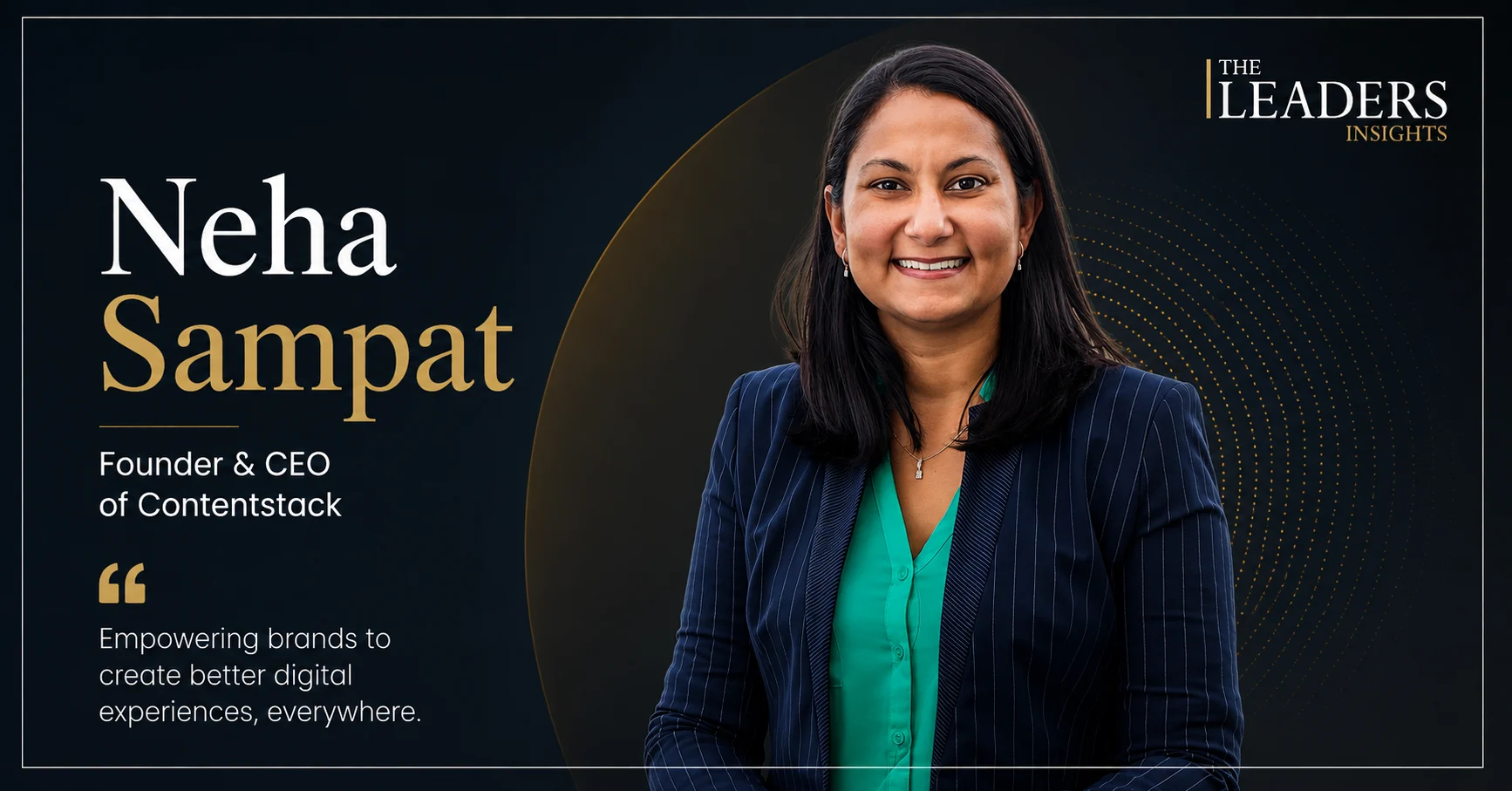
Neha Sampat’s leadership journey reflects this kind of executive evolution. As the founder and CEO of Contentstack and a serial entrepreneur in the technology sector, her story offers more than a profile of business growth. It offers a perspective on what it means to lead when the path is not already designed for you.
For CEOs, founders, university leaders, healthcare executives, and CXOs, Sampat’s journey offers an important lesson: leadership is not only about fitting into an existing industry mold, but also about expanding what that mold can become.
Building Authority Without Following the Traditional Script
Many leaders enter executive roles through familiar pathways: technical training, elite institutional networks, corporate progression, or early access to capital. Sampat’s journey stands apart because it challenges the assumption that credibility must come from a conventional background.
In highly technical industries, leaders are often expected to prove their credibility through engineering experience or a strong track record of building products. Sampat’s rise demonstrates a different kind of strength: the ability to understand markets, customers, teams, and timing with unusual clarity.
This is not a softer form of leadership. It is a different form of strategic intelligence.
Technology companies do not succeed because the product works; they succeed when the product solves a meaningful problem, when customers understand its value, when teams believe in the mission, and when the market is ready to move. Leaders who can connect these dimensions often become powerful company builders.
Sampat’s career shows that executive authority is not granted by background alone. It is earned through judgment, consistency, and the ability to translate complexity into direction.
Turning Market Understanding Into Category Leadership
One of the most important lessons from Sampat’s leadership journey is the value of seeing where the market is going before the majority has fully arrived there.
Contentstack grew in a space shaped by major shifts in digital experience, composable technology, headless content management, and enterprise transformation. These were not simply product trends. They reflected a broader change in how organizations wanted to manage digital experiences across channels, teams, and systems.
For enterprise leaders, this is a meaningful distinction. Category leadership is rarely created by reacting to demand after it becomes obvious. It is built by recognizing early signals, educating the market, and helping customers understand why a new approach matters.
Sampat’s leadership reflects the patience required to build in a market that must be developed, not merely served. That requires a different level of conviction. Founders and executives must be willing to explain the future before the language around that future becomes widely accepted.
This is especially relevant in the United States, where companies across industries are now rethinking digital infrastructure, customer experience, AI adoption, and data-driven operations. The leaders who win will not be those who follow every trend. They will be those who understand which structural shifts are worth building around.
Leadership Is Also the Discipline of Rebuilding
Entrepreneurial leadership is often romanticized as a story of starting once and scaling smoothly. In reality, many strong leaders are shaped through repeated acts of rebuilding.
Sampat’s journey includes founding, scaling, evolving, and beginning again. That pattern is significant. It shows that transformation is not a single event in a leader’s career. It is a recurring discipline.
Every organization reaches moments where its existing model must be questioned. A services business may need to become a product company. A growing platform may need to mature into an enterprise-grade organization. A founder-led culture may need to develop executive systems without losing its original energy.
These transitions are challenging because they require leaders to move beyond the methods that once created success and develop the capabilities needed for the next stage of growth.
Sampat’s leadership journey offers a clear lesson: building is important, but rebuilding is where long-term leadership is tested.
Culture as a Strategic Operating Force
In executive conversations, culture is sometimes treated as separate from performance. The strongest leaders understand that culture is one of the systems through which performance is created.
Sampat has been associated not only with company building but also with advocacy around women in leadership, workplace equity, and purpose-driven organizational culture. This matters because technology companies are not only competing for customers. They are competing for talent, trust, creativity, and long-term commitment.
In sectors such as healthcare, education, finance, and enterprise technology, culture influences how people make decisions under pressure. It affects whether teams collaborate or protect silos. It determines whether employees raise risks early or hide them until they become problems. It shapes how organizations respond to complexity.
For leaders in the American business environment, this is a strategic issue. A company can have strong funding, a promising product, and a growing market, but if its culture cannot scale, the organization will eventually feel the strain.
Sampat’s leadership reminds executives that culture is not an internal accessory. It is part of the architecture of sustainable growth.
Real-World Perspective: The Power of Being Different in the Room
One of the most relevant aspects of Sampat’s journey is that she has often represented a different kind of leader in rooms where expectations were already established. A woman founder in enterprise technology. A non-traditional leader in a technical sector. A builder who moved across services, software, and platform categories.
That difference can become a challenge. It can also become an advantage.
Leaders who do not fit the expected profile often develop sharper awareness. They learn to listen closely, communicate clearly, build alliances carefully, and prove value through substance rather than assumption. They become skilled at seeing gaps others may miss because they have had to navigate systems from a different angle.
This perspective is valuable far beyond technology. University leaders, healthcare executives, founders, and institutional leaders all face moments when their differences become part of their leadership identity. The question is whether they try to minimize it or use it to create a wider field of possibility.
Sampat’s journey suggests that difference, when paired with excellence and conviction, can become a source of executive strength.
A Forward-Looking Lesson in Modern Leadership
The next generation of leadership will not be defined by background, leadership style, or traditional pathway to authority. The future will belong to leaders who can combine market intelligence with human understanding, ambition with patience, and growth with culture.
Neha Sampat’s leadership journey reflects this modern executive profile. It is a story of building across stages, leading through difference, and creating credibility in spaces where the expected path was not always available.
For CEOs, founders, university leaders, healthcare executives, and CXOs, the broader lesson is clear. Leadership is not about perfectly matching an industry’s past expectations. It is about building the judgment, courage, and institutional discipline to shape what comes next.
The strongest leaders do not simply enter existing categories. They help redefine them.
And in doing so, they create a path that others can follow with greater confidence.