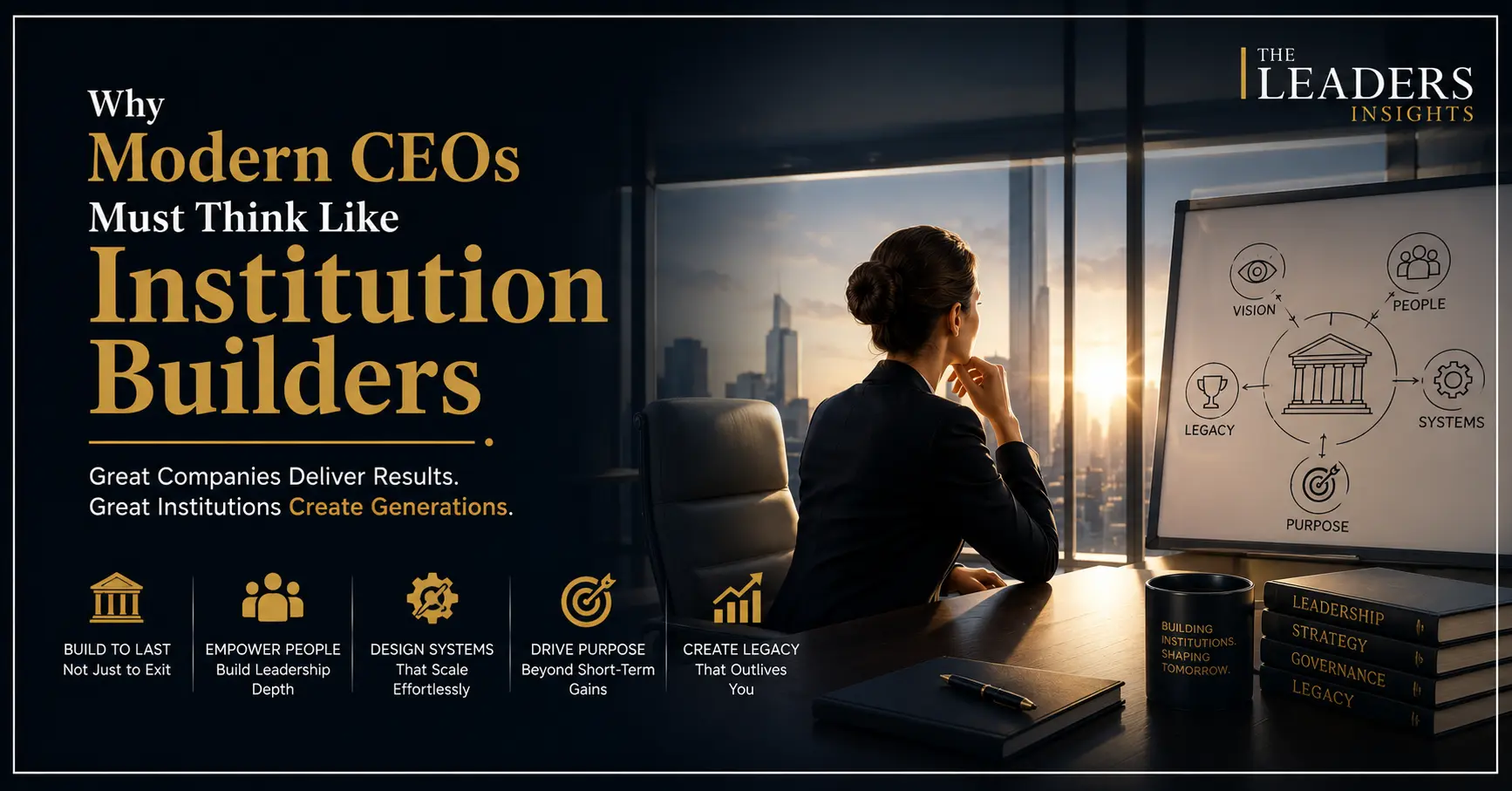
Why Modern CEOs Must Think Like Institution Builders
The definition of corporate leadership has shifted from delivering quarterly performance to building enduring human institutions. In an era defined by rapid technological disruptions, shifting geopolitical alignments, and fluid labor dynamics, the traditional playbook of maximizing short-term shareholder value is no longer sufficient. For American CEOs, university presidents, and healthcare executives, the mandate has evolved. True leadership requires moving beyond the mindset of an operator or an optimization engine. Leaders must adopt the vision of an institution builder, an architect who creates structures capable of outlasting their own tenure and weathering systemic shocks.
This shift represents a fundamental philosophical change in executive governance. Operating a business focuses on transactional scale, margin optimization, and predictable quarters. Building an institution, however, focuses on cultural integration, systemic resilience, and social trust. When an enterprise transitions from a mere market participant to an institution, it establishes a legacy that actively shapes its industry, stabilizes its ecosystem, and defines its societal footprint.
The Paradigm Shift: From Operator to Architect
The modern executive operating environment rewards velocity, yet institutional durability demands stability. This paradox requires leaders to manage a dual reality: executing immediate strategic pivots while safeguarding the enterprise’s core values and foundational infrastructure.
Operators look at an organization and see assets to deploy. Institution builders look at an organization and see an ecosystem to sustain. This architectural mindset requires a deep commitment to governance frameworks that decouple the organization’s long-term health from individual personalities or single product cycles. For CXOs and founders across the United States, this means embedding institutional memory, rigorous succession pipelines, and adaptable compliance mechanisms directly into the corporate blueprint. By prioritizing systemic continuity over individual brilliance, an institution develops the capacity to absorb macroeconomic shocks without losing its strategic north star.
Capital Allocation as a Multi-Generation Strategy
Institution builders view capital through a lens of generational stewardship rather than immediate return on investment. While the public markets demand immediate metrics, institutional leaders intentionally allocate resources toward foundational capabilities:
- Substantive Research and Development: Investing in core technologies and methodologies that secure market relevance a decade into the future.
- Deep Talent Ecosystems: Creating internal academies and robust mentorship pipelines that treat human capital as a core asset rather than an operational expense.
- Structural Infrastructure: Upgrading technological, operational, and physical architecture to support long-term, scalable growth.
This strategic approach to capital allocation ensures that short-term market downturns do not compromise the organization’s future capacity. It requires clear, transparent communication with board members and institutional investors to align financial expectations with the longer horizon required for true legacy creation.
Cultivating an Immutable Cultural Core
Products, services, and corporate strategies must continuously adapt to survive, but an institution’s core values must remain steady. The institution builder understands that culture is the ultimate operational guardrail. When an organization scales globally or navigates decentralized hybrid work environments, centralized policy cannot police every decision.
A deeply internalized ethical and operational framework serves as the primary mechanism for decentralized risk management. Leaders build these institutional cultures not through superficial corporate slogans, but by aligning incentives, promotion criteria, and executive accountability with core institutional values. When decisions at every level of the enterprise are guided by a shared sense of purpose and long-term responsibility, the organization creates a powerful premium that attracts top talent, secures client loyalty, and protects its brand equity.
Restoring and Navigating Social Trust
American institutions across sectors, corporate, academic, and medical, face a complex environment of shifting public trust. In this climate, a modern CEO cannot operate in isolation from the broader social fabric. Institution builders recognize that corporate longevity is directly tied to the health of the communities, regulatory environments, and economic systems in which they operate.
Navigating this reality requires proactive engagement with a broad group of stakeholders, including regulators, academic partners, community leaders, and industry consortia. By positioning the enterprise as a stabilizing, value-creating entity within society, leaders build a reserve of social capital. This institutional trust acts as an essential buffer during crises, transforming external stakeholders from potential critics into vital partners in resilience.
Real-World Perspective: The Anatomy of Longevity
Looking at enduring global organizations reveals a common thread: their most transformative leaders consistently prioritized structural health over personal legacy. Consider the evolution of major American healthcare systems or storied academic institutions during times of national crisis. The leaders who successfully guided these organizations did not focus on short-term balance sheet expansion. Instead, they modernized governance, forged deep public-private partnerships, and invested in systemic capabilities that bore fruit decades later.
Similarly, in the technology and industrial sectors, companies that successfully navigated major shifts did so because their executives viewed their firms as institutions. They understood that their current product lines were transitory, but their collective capability, intellectual property infrastructure, and brand trust were permanent. They managed their balance sheets with the conservative strength required to survive downturns, while fostering an internal culture of disciplined experimentation.
The Forward-Looking Executive Mandate
The ultimate metric of an institution builder is what happens after they step down. True executive success is found in the smooth, predictable continuation of excellence under the next generation of leadership. As we look toward an increasingly complex global economic horizon, the call for institution-building becomes urgent.
For the modern CEO, founder, or institutional leader, this requires a deliberate focus on long-term stewardship. It means building organizations that are not only highly efficient today, but are fundamentally built to last. The leaders who embrace this architectural mindset will do more than just survive market cycles; they will build the foundational pillars of our collective economic future.