
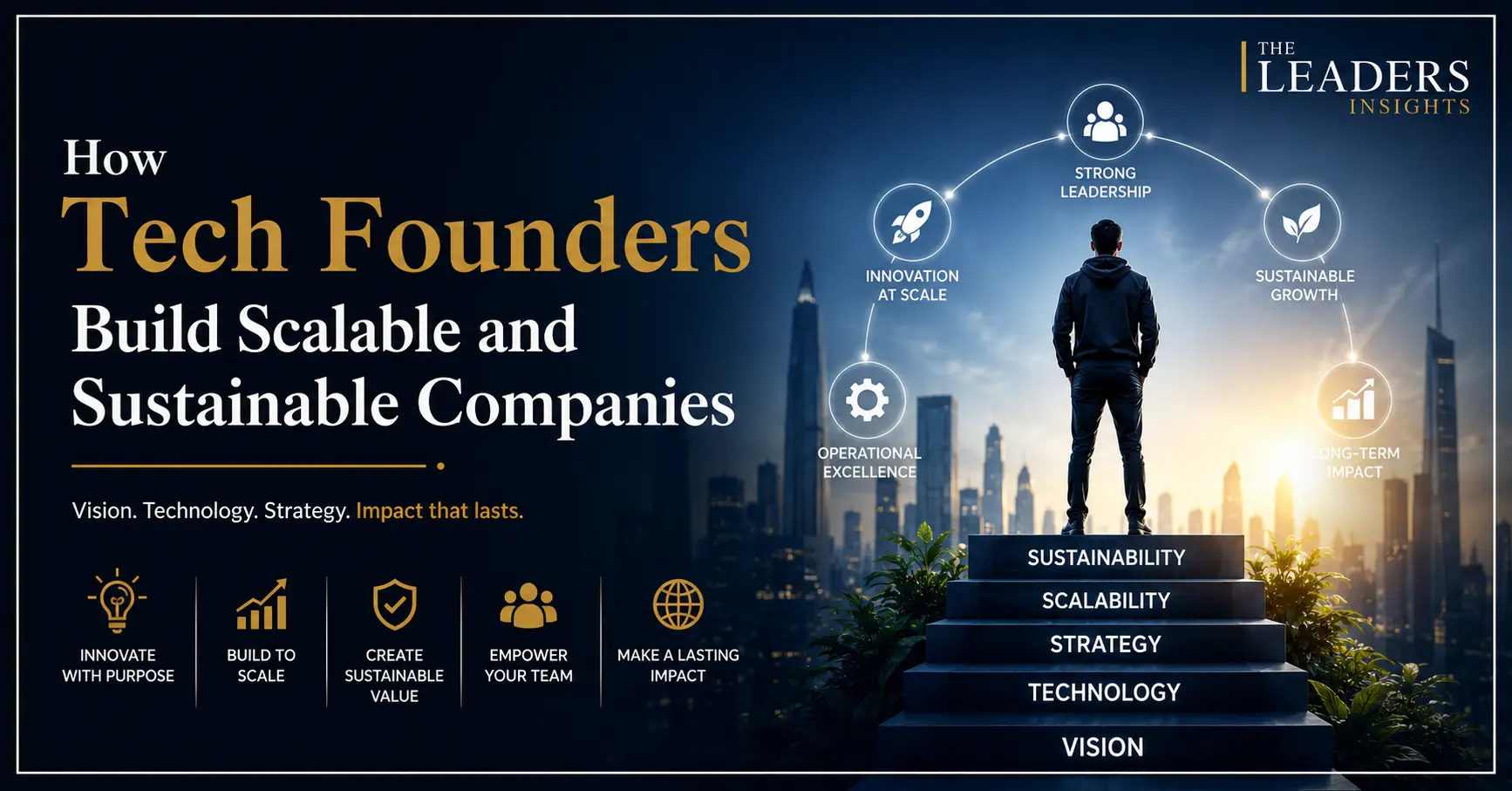
How Tech Founders Build Scalable and Sustainable Companies
The defining challenge for the modern American tech founder has evolved from a race for unbridled velocity to a rigorous pursuit of structural durability. For more than a decade, the Silicon Valley playbook prioritized hyper-growth at all costs; subsidizing customer acquisition through continuous, dilutive venture rounds and chasing raw user scale over unit economics.
However, a transformed macroeconomic landscape characterized by capital discipline and high interest rates has rendered that model obsolete. Today, the highest-performing CEOs, founders, and CXOs across the United States recognize that true enterprise scale is meaningless without architectural sustainability. Building a company capable of category dominance now requires shifting from a culture of continuous experimentation to one of deliberate, institutional engineering.
This transition marks a philosophical realignment within technology governance. Scalability is no longer viewed merely as an engineering or optimization challenge; it is a holistic cross-functional discipline encompassing capital efficiency, predictable revenue systems, and immutable operational infrastructure.
The Capital Optimization Mandate: Efficiency as an Asset
Sustainable scale begins with a fundamental re-engineering of the balance sheet. In high-capital-velocity tech sectors, the most resilient founders have abandoned total venture capital raised as a proxy for enterprise success. Instead, they treat capital efficiency (manifested in optimized burn multipliers and positive free cash flow) as a strategic defensive asset.
The Paradox of Scalable Technical Systems
Core Interdependencies of Modern Scale
- Continuous Operational Optimization (LTV: CAC > 3x)
- Technical Debt Remediation (Predictive Architecture)
- Structural Talent Retention (Institutional Memory)
Operating a technology enterprise sustainably requires aligning customer acquisition costs (CAC) with long-term customer lifetime value (LTV) from the earliest stages of scale. High-performing founders focus on creating a highly disciplined operational blueprint where the unit-level profitability remains robust even as the organization expands into new, complex market segments. By ensuring that every unit of deployed capital compounds value rather than merely inflating transactional volumes, these organizations decouple their growth trajectory from the volatile cycles of external capital markets.
Engineering Product-Led Ecosystems Over Linear Features
True scalability requires moving beyond linear software delivery and toward building comprehensive, platform-based ecosystems. Technology founders frequently make the mistake of scaling their sales infrastructure before their core platform achieves genuine architectural stability. This structural miscalculation introduces severe operational drag, leading to customized codebases for single enterprise clients and high churn rates.
Sustainable founders address this by prioritizing a product-led growth framework. They invest heavily in building extensible, API-first software architectures that integrate seamlessly into their clients’ core technology systems. When software operates as an essential infrastructural utility rather than an easily displaced point solution, the enterprise secures high net revenue retention (NRR). This deep platform integration establishes predictable, recurring revenue streams that act as a stabilizing foundation, allowing the company to invest aggressively in next-generation research and development.
Remediating Technical and Operational Debt Proactively
Just as financial debt can cripple an expanding balance sheet, accumulated technical and operational debt is a primary threat to long-term corporate durability. In the early phases of development, shortcuts in data schemas, infrastructure architecture, and organizational governance are often necessary to achieve speed-to-market. However, left unaddressed, these compromises harden into structural bottlenecks that paralyze a company as it attempts to scale.
Founders building for the next decade treat the technical debt as a core executive metric. This approach requires establishing a governance framework where engineering and product teams systematically allocate a fixed percentage of the development cycle to refactoring legacy systems, upgrading data privacy compliance, and ensuring cross-platform security. By maintaining a clean, highly automated operational infrastructure, the enterprise ensures that future scale decreases marginal costs rather than increasing organizational complexity.
Real-World Perspective: The Transformation of Enterprise SaaS
The real-world proof of this strategic evolution is evident across the modern enterprise software and infrastructure landscapes. Consider the tech firms that have successfully navigated tectonic platform shifts from legacy on-premise solutions to cloud deployment, and now into institutionalized artificial intelligence platforms. The common denominator among these enduring organizations is that their executives consistently chose to sacrifice short-term valuation spikes to preserve structural integrity.
Whether optimizing cloud infrastructure margins, modernizing complex data analytics platforms, or refactoring large-scale enterprise workflows, these leaders have proven that technological durability requires operational discipline. They have deliberately structured their sales incentives around long-term customer success rather than initial transactional bookings, resulting in organizations that demonstrate exceptional resilience during broader macroeconomic downturns.
The Forward-Looking Founder Mandate
As the American technology ecosystem enters a mature phase of integration, the criteria for elite founder performance have been permanently reset. The era of the speculative operator has given way to the era of the institutional architect.
For modern CEOs, founders, and institutional stakeholders, building a sustainable company is an operational obligation rather than an ideological choice. Actively designing an enterprise around capital efficiency, platform scalability, and systemic debt remediation represents the most secure path to category leadership. The future of global commerce will be built on resilient, highly scalable digital platforms, and the tech leaders who embrace this holistic governance model today are those who will anchor our economic infrastructure for decades to come.